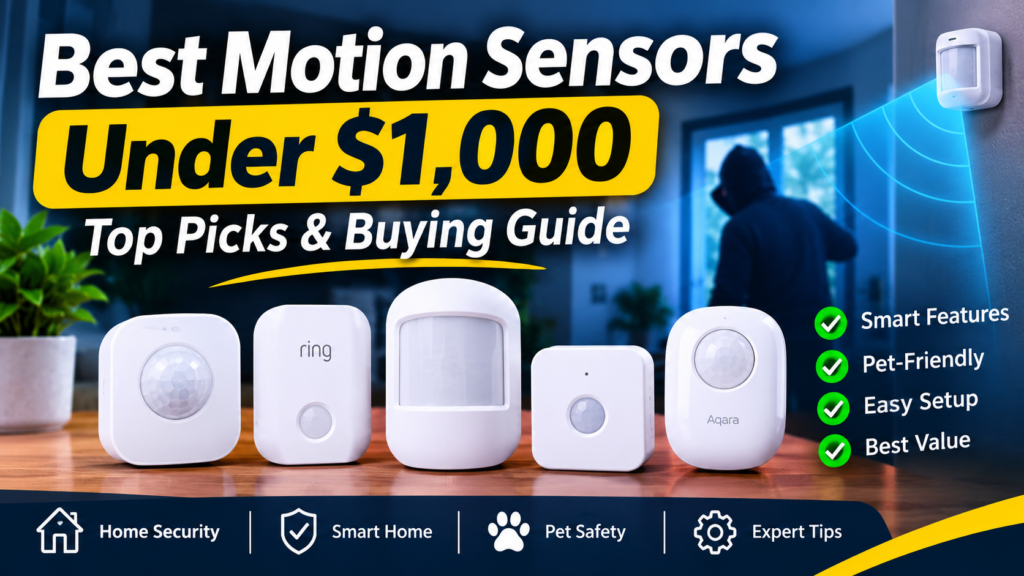
Six battery-powered motion sensors from different brands lined up on a shelf beside a phone showing a motion alert
Prices and specifications checked November 12, 2026, in US dollars. Gadget Sentinel has not physically tested these products. Everything below comes from manufacturer documentation, retailer spec sheets and published third-party reviews, and we label which is which.
Introduction
The best motion sensors under $1,000 almost never cost anywhere near $1,000. Most individual sensors in this guide sell for $22 to $85, and the “pro-grade” detectors run roughly $75 to $120 through dealers. A larger budget mostly buys more sensors, a hub, or installation labor, not a smarter detector. Treat $1,000 as a ceiling, not a target.
Two things matter more than price. First, what the sensor is for: triggering a light, sending an alert, or feeding an alarm panel are different jobs. Second, what it plugs into: Thread, Zigbee, Z-Wave and proprietary alarm radios do not talk to each other.
This guide separates individual sensors (what you pay once), multi-sensor systems (sensors plus a hub or panel) and professional installations (labor and monitoring). Motion detection is one piece of a layered approach to smart home security, and no sensor can guarantee that a break-in won’t happen. Prices are USD. UK and Canadian buyers should confirm local availability, radio frequency and warranty terms before ordering.
Quick Comparison: Best Motion Sensors Under $1,000
| Product | Best for | Detection technology | Range / field of view | Connectivity | Pet immunity | Approx. price (USD) | Main limitation |
|---|---|---|---|---|---|---|---|
| Aqara Motion and Light Sensor P2 | Best overall smart sensor | PIR + light sensor | Up to 7 m (23 ft), ~170° | Matter over Thread, Bluetooth | Not specified | $33.99 | Needs a Thread border router; indoor only |
| Aqara Presence Multi-Sensor FP300 | Best mmWave presence | PIR + 60 GHz mmWave | Up to 6 m (20 ft), 120° | Thread/Matter or Zigbee | Not rated | $49.99 | Built for automation, not certified alarms |
| Eve Motion (Matter) | Apple-first homes, covered outdoor spots | Infrared + light sensor | 9 m (30 ft), 120° | Thread/Matter | Not specified | ~$40–55 | IPX3 splash rating only; needs a border router |
| Zooz ZSE18 800LR | Best Z-Wave sensor | PIR | 25 ft front, 13 ft sides, 120° | Z-Wave 800 / Long Range | Not specified | ~$22–38 | Needs a Z-Wave hub; indoor only |
| Ring Motion Detector | Ring and Alexa households | Motion (PIR assumed) | 30 ft, 90° | Amazon Sidewalk or Z-Wave | Not stated | $39.99 | Ring ecosystem; plan needed for monitoring |
| Philips Hue Motion Sensor | Hue lighting automations | Motion + daylight | Not published | Zigbee/Bluetooth via Bridge | Not stated | $48.99 (+ $79.99 Bridge) | Bridge required; lighting-first |
| SimpliSafe Motion Sensor | Pet-friendly DIY alarm | PIR | 30 ft, 90° (retailer listings) | SimpliSafe radio | Pets under ~50 lb | ~$29 | Works only with SimpliSafe |
| Honeywell Home 5800PIR family | Professional and large properties | PIR (5898 is dual-tech) | 35×40 ft; up to 60×80 ft | 345 MHz 5800-series | Up to 80 lb (RES, PIR) | ~$73–120+ via dealers | Needs a compatible Honeywell/Resideo panel |
Ring and Hue don’t name their sensing technology on their product pages, so “PIR” for Ring is our assumption based on the product class. Dealer prices for Honeywell vary widely.
Best Motion Sensors Under $1,000: Detailed Reviews
We did not force eight winners. The picks below are distinct because they solve different problems, and none needs more than about $130 even with a hub.
Best Overall Smart Motion Sensor: Aqara Motion and Light Sensor P2

- [Native Matter Support over Thread] The Aqara Motion and Light Sensor P2 seamlessly integrates with Matter, ensuring bro…
- [2-in-1 Sensor] The Aqara Motion and Light Sensor P2 combines a PIR motion sensor with a separate light sensor, enabling…
- [Wide Viewing Angle & Detection Range] The P2 sensor can detect movement across a wider area range of up to 7 meters/23 …
Overview: A small battery-powered PIR sensor with a separate light sensor, using Matter over Thread. At $33.99 on Aqara’s US store, it is the cheapest route into Matter motion sensing.
Specs: Retailer listings relaying Aqara’s figures give up to 7 m (23 ft) range and roughly 170° horizontal coverage (some retailers quote narrower angles at full range). Two CR2450 batteries, up to two years claimed. Indoor only, -10 to 55 °C.
Pros: Low price, wide coverage, light-based automations, local Matter control.
Cons: No pet immunity is stated, and retailer spec tables list no tamper switch. It needs a Matter controller and Thread border router. One-year warranty.
Installation and compatibility: Magnetic bracket, no wiring. Works with Apple Home, Alexa, Google Home and SmartThings through Matter.
Who should buy it: Smart-home users who want automations plus basic alerts. Who should avoid it: Anyone who needs an alarm-panel detector or has a large dog.
Best mmWave Presence Sensor: Aqara Presence Multi-Sensor FP300

- [Precise AI-Powered Presence Sensor] Powered by advanced AI, PIR, and 60GHz mmWave radar, the FP300 accurately detects h…
- [Broad Compatibility] Supports Matter over Thread and Zigbee for seamless integration with major ecosystems. Works with …
- [5-in-1 Multi-Sensor] Combines 60GHz mmWave, PIR, light, temperature, and humidity sensors into one compact device. This…
Overview: Combines PIR and 60 GHz mmWave radar so lights stay on when you sit still. The FP300 costs $49.99 on Aqara’s US store.
Specs: Up to 6 m (20 ft) and 120° per retailer listings. Two CR2450 batteries, rated up to two years on Thread or three years on Zigbee under Aqara lab conditions. Also reports temperature, humidity and light.
Pros: True presence detection, battery power, dual protocol.
Cons: Aqara says Zigbee mode and an Aqara hub unlock the longest battery life and advanced features. Pet filtering is marketing language, not independent test data. Aqara’s older Wi-Fi FP2 (USB-C powered) is still sold by retailers, but Aqara’s US menu now lists the FP300 and FP400.
Who should buy it: Bedrooms, offices and bathrooms where PIR switches lights off on you. Who should avoid it: Buyers wanting a certified intrusion detector.
Best Matter Sensor for Apple Homes and Covered Outdoor Spots: Eve Motion
Overview: Eve’s support page lists 120° coverage, 9 m (30 ft) at a 2 m (6.5 ft) mounting height, and IPX3 certification for indoor and outdoor use.

- 120° field of view and up to 9 m detection range. Indoors and outdoors thanks to IPX3 water resistance and wireless batt…
- Control your lights and appliances with movement, and receive notifications when motion is detected (available on select…
- Matter-enabled to let you seamlessly monitor your home across smartphones and voice assistants of all major platforms. C…
Specs: Thread with Matter, two replaceable AAA batteries, a 0 to 15,000 lux twilight setting, operating range -18 °C to 55 °C. It requires a Matter controller and Thread border router.
Pros: Splash-resistant, replaceable standard batteries, no proprietary hub.
Cons: IPX3 means splash resistance, not heavy-weather protection. Pet immunity isn’t stated. Pricing runs about $40 to $55 depending on the retailer (launch price was $39.95).
Who should buy it: Apple Home users who want one sensor under a porch or in a garage. Who should avoid it: Households without a Thread border router.
Best Z-Wave Motion Sensor: Zooz ZSE18 800LR
Overview: Zooz’s ZSE18 manual describes an 800-series Z-Wave Long Range sensor with S2 security and AES-128 encryption.

- FAST DETECTION: Reports motion to your Z-Wave smart home system reliably. Great solution for light automation and securi…
- EXTRA FEATURES: Adjustable motion sensitivity and retrigger time. Built-in Z-Wave range test tool for easier network tro…
- 2 POWER SOURCES: Runs on a single battery for up to a year (depending on traffic and settings) OR on micro USB cable (NO…
Specs: 25 ft front range, 13 ft side range, 120° angle. Z-Wave range up to 150 ft, or 1,300 ft with Long Range. Powered by one CR123A or micro-USB; on USB it acts as a repeater. Indoor only, 32 to 104 °F. Retailers list it around $22 to $38.
Pros: Long radio range, strong security, local control, 1-year warranty (5 years extended after registration).
Cons: Requires a Z-Wave controller. Pet immunity isn’t stated, though a third-party guide lists adjustable sensitivity. The manual covers the US/CA/MX region; European-frequency versions are sold separately.
Who should buy it: Home Assistant, Hubitat and SmartThings users. Who should avoid it: Anyone without a Z-Wave hub.
Best for Ring and Alexa Households: Ring Motion Detector
Overview: Ring’s product page lists $39.99, a 30 ft range, 90° field of view, two AA batteries (up to two years) and a one-year warranty.
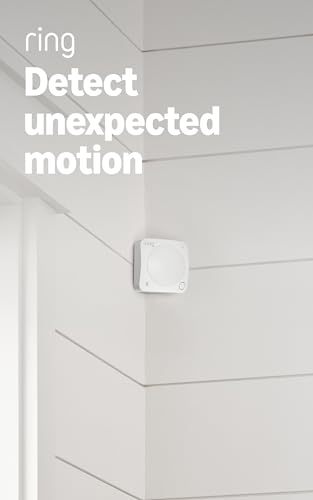
- Instant motion-activated alerts — One sensor watches an entire room (30 ft. range, 90° field of view).
- Pet-friendly — Customize settings to reduce false alerts from pets under 50 lbs.
- No base station required — connects over Amazon Sidewalk for simple, flexible coverage throughout your home and beyond (…
Connectivity: Amazon Sidewalk or Z-Wave (a Ring Alarm base station is required for Z-Wave). Ring says connecting is free, but remote arm/disarm and 24/7 professional monitoring need a compatible Ring Protect plan.
Cons: Pet immunity isn’t stated on the page. Sidewalk coverage is described in US terms, so check your area. Two-pack: $69.99.
Who should buy it: Ring Alarm owners adding rooms. Who should avoid it: Non-Ring and non-Alexa homes.
Best for Philips Hue Lighting: Hue Motion Sensor

- WHAT'S IN THE BOX – Includes one Hue Motion Sensor and two AAA batteries; Automates your smart lights to respond to move…
- REQUIRES A HUE BRIDGE – Unlock the power of Hue and enjoy automations control from anywhere in the world, and a secure, …
- TRIGGER LIGHTS WITH MOVEMENT – The wireless battery-powered Hue Motion Sensor automatically turns on your smart lights w…
Overview: Philips Hue’s indoor sensor costs $48.99 but requires a Hue Bridge ($79.99; Bridge Pro $149.99). It uses Zigbee and Bluetooth, includes a daylight sensor, and can group up to 12 sensors.
Specs: IP20 (indoor), 0 to 40 °C, two AAA batteries, two-year warranty, and a minimum 60-month support period. Hue doesn’t publish detection range on this page.
Pros: Polished scheduling and Matter via the Bridge.
Cons: Lighting-first design, bridge cost, no pet data. Hue says the sensor can be used for security monitoring without lights, but it is not an alarm detector.
Who should buy it: Existing Hue owners. Who should avoid it: Anyone buying only for security.
Best Pet-Friendly Motion Sensor for DIY Alarms: SimpliSafe Motion Sensor

- Motion sensor – Add an extra layer of protection inside your home. Designed to detect motion within 30 feet and has a 90…
- Covers large rooms – With 90 degree field of view, place the motion sensor in a corner for maximum room coverage
- Pet-friendly – Reduces false alarms by ignoring pets under around 50 lbs
Overview: SimpliSafe’s detector appears at about $29 at retail and works only with SimpliSafe systems. Listings describe a 90° field of view, 30 ft range (one newer listing says adjustable to 45 ft), and pets under roughly 50 lb being ignored.
Pros: Peel-and-stick installation, pet filtering, optional monitoring.
Cons: Locked to one ecosystem, and one retailer review reports a cat still triggering it. Test with your own pets.
Who should buy it: Existing SimpliSafe owners with cats or small dogs. Who should avoid it: Anyone planning to mix brands.
Best Professional Security Sensor and Best for Large Properties: Honeywell Home 5800PIR Family
Overview: These are installer-grade wireless PIRs for Honeywell/Resideo 5800-series panels. The 5800PIR-RES is a 345 MHz detector with fixed pet immunity up to 80 lb and a 35×40 ft pattern.

- Motion Detector
- Model Number: 5800PIR
- Item Package Dimensions: 5.6" L x 6.3" W x 9.4" H
Specs and variants: A dealer lists the RES at about $73 to $85, with up to five years of battery life and a two-year warranty. The 5800PIR adds selectable pet immunity (0 or 80 lb) and self-test, and one dealer lists it around $119. The 5800PIR-COM covers 60×80 ft or 100×20 ft and has no pet immunity, per Honeywell’s spec sheet. A wireless dual-technology 5898 (50×60 ft) and a 40 ft outdoor 5800PIR-OD2 are also catalogued.
Cons: Dealer pricing swings widely, and it needs a compatible panel, usually professionally programmed. The 345 MHz line is North American.
Who should buy it: Homes and light-commercial spaces on Honeywell panels. Who should avoid it: Anyone without a compatible panel.
How Motion Sensors Work: PIR, Microwave, Dual-Technology and mmWave
PIR (passive infrared) sensors watch for heat moving across their lens zones. They emit nothing, they’re cheap and low-power, and most sensors above are PIR. Sunlight, heaters and drafts can fool them, and they struggle with someone sitting still.
Microwave detectors transmit radio energy and measure reflections, so they sense movement rather than heat. They can see through thin partitions, which is good for coverage and bad for false alarms.
Dual-technology sensors require both PIR and microwave to agree before alarming, which cuts false triggers. Honeywell’s 5898 is an example.
mmWave is radar at very high frequency (the FP300 uses 60 GHz). It picks up tiny motions such as breathing, so it can tell that a room is occupied even when nobody moves. Fans, curtains and adjacent rooms can still cause false triggers, so placement and tuning matter.
Motion Sensors vs Presence Sensors
A motion sensor answers “did something just move?” A presence sensor answers “is someone still here?”
If you walk down a hallway at night, a PIR sensor is perfect: it fires, the light comes on, it times out. If you’re reading on the sofa, PIR may report the room empty and switch the lights off, while mmWave keeps them on. For intrusion alerts, you generally want a motion event with fast response. For comfort automation, you want presence.
Because presence sensors are designed mainly for automation, check the manufacturer’s documentation before relying on one as your only intrusion detector.
Important Features to Consider Before Buying
- Range and detection angle: Typical rated ranges here are 20 to 35 ft. Honeywell’s wireless line reaches 35×40 ft, and its long-range variant 60×80 ft.
- Sensitivity: Look for adjustable levels. Too sensitive means false alerts, too low means missed events.
- Pet immunity: Ratings are weight-based (SimpliSafe about 50 lb, Honeywell 80 lb). They depend on mounting height and don’t help if a pet jumps on furniture.
- Connectivity: Thread/Matter, Zigbee and Z-Wave each need a compatible hub or border router. Z-Wave is regional, so buy for your country.
- Battery life: Claims run from about two years (Ring, Aqara) to five years (Honeywell). Real life varies with activity and temperature.
- Weather resistance: Eve’s IPX3 and Hue’s outdoor IP54 are splash ratings. Most other sensors here are indoor only.
- Privacy and cloud dependency: Matter and Z-Wave devices can run locally. Ring’s Sidewalk and monitoring features rely on Ring’s cloud and plans. Prefer products that document encryption, such as Zooz’s S2/AES-128.
Wired vs Wireless Motion Detectors
Wired detectors are powered and supervised by the panel, so there are no batteries to forget, but they require cable runs. They suit new builds and larger installs, which is where a professional helps. Wireless motion detectors install in minutes and move with you, but they depend on batteries and radio signal. In practice, wireless is the right default for renters and retrofits, as our guide on DIY versus professional home security systems explains. Replace batteries on a schedule rather than waiting for a low-battery warning.
Best Home Security Motion Sensors for Different Applications
- Apartments: Aqara P2, Zooz or Ring. One sensor covering the entry path is usually enough, and no drilling is needed.
- Large homes: Honeywell 5800PIR-COM on a compatible panel, or several Z-Wave sensors using Long Range.
- Offices: FP300 for presence-based lighting and HVAC, plus a PIR for after-hours alerts.
- Commercial buildings: Dual-technology and tamper-supervised detectors via an installer. Honeywell’s spec sheet notes that tamper protection is required for commercial certificated installs.
- Outdoor areas: Eve Motion (covered spots), Hue Outdoor (IP54) or Honeywell’s 5800PIR-OD2. Don’t use indoor-only sensors outside.
- Pet-owning households: Honeywell (80 lb) or SimpliSafe (about 50 lb), or mmWave presence sensors for automations.
How Much Should You Spend?
- Under $50: One sensor. Most picks here fit (Aqara, Zooz, Ring, SimpliSafe, and Eve at the low end). Enough for a hallway alert or a lighting automation.
- $50 to $150: Two or three sensors, or an installer-grade Honeywell detector, or a Hue sensor plus Bridge (about $129).
- $150 to $300: A starter kit. Ring lists a 5-piece alarm kit at $199.99, and our home security gadgets guide puts SimpliSafe’s base kit around $251.
- $300 to $500: A whole-home sensor set (eight to ten sensors at roughly $35 to $50 each is our own arithmetic) with a hub.
- $500 to $1,000: Professional installation and monitoring. Ring’s cart lists installation from $129.99 per device. Spend the rest on cameras, such as our best premium security cameras under $1,000, rather than a pricier motion sensor.
Ownership costs: batteries, hub or bridge purchases, monitoring plans, and ecosystem lock-in. Our home security system buying guide shows how to compare three- and five-year costs.
Installation and Placement Tips
- Mount at the manufacturer’s height. Zooz suggests about 7 ft within 20 ft of the door, Eve 6.5 ft, and Honeywell dealers cite 7 to 9 ft.
- Aim across the path, not down it. PIR sensors detect crossing movement best.
- Use corners for a wide room view, as SimpliSafe suggests.
- Avoid windows, radiators and vents. Sunlight and heat cause false triggers.
- Keep pets off the pattern. Pet immunity works only at the intended height.
- Walk-test and adjust sensitivity before permanent mounting. Our DIY home security setup guide includes a test list.
Frequently Asked Questions
What is the best motion sensor for home security?
It depends on your system. Match the sensor to your panel (Ring, SimpliSafe or Honeywell) for true alarm use, or choose Aqara P2 or Zooz for smart-home alerts.
Are expensive motion sensors worth buying?
Rarely. Sensors above about $120 are generally paying for panel compatibility, tamper protection or installer support, not better detection.
What is the difference between PIR and mmWave sensors?
PIR senses moving heat and is fast and cheap. mmWave uses radar and can detect stationary people, but needs tuning to avoid fan and curtain triggers.
Can motion sensors detect pets?
Standard PIR sensors can. Pet-immune models ignore animals up to a rated weight (50 lb for SimpliSafe, 80 lb for Honeywell). Test in your own home.
Do motion sensors work without Wi-Fi?
Many do. Z-Wave, Zigbee and Thread sensors talk to a hub, not your router. Remote alerts still need internet. Hue states its sensor works without Wi-Fi.
How far can a typical motion sensor detect movement?
About 25 to 35 ft in this guide. Aqara P2 reaches 7 m (23 ft), Ring 30 ft, and Honeywell’s long-range model 60×80 ft.
Are wireless motion sensors reliable?
Yes, when batteries are maintained and signal strength is good. Run range tests at install time, as Zooz’s manual describes.
Can motion sensors work with Alexa and Google Home?
Many can. Matter sensors (Aqara P2, Eve) work across Apple, Google and Alexa through a controller, and Hue supports them via its Bridge. Ring is Alexa-centric. Confirm each model’s compatibility.
What is the best motion sensor for a large house?
Zooz’s Long Range radio helps with distance, and Honeywell’s 5800PIR-COM covers the biggest rooms, though it needs a compatible panel.
How many motion sensors does a typical home need?
Our buying guide suggests roughly one for an apartment, one to two for a small house, and one per floor for a two-story home. These are planning ranges, not test results.
Final Verdict
There is no single winner:
- Most people: Aqara P2 for the price and Matter support.
- Rooms where you sit still: Aqara FP300.
- Apple Home with a covered patio: Eve Motion.
- Z-Wave hubs: Zooz ZSE18 800LR.
- Ring owners: Ring Motion Detector.
- Hue lighting: Hue Motion Sensor.
- Cats and small dogs on SimpliSafe: SimpliSafe Motion Sensor.
- Large or commercial spaces: Honeywell 5800PIR family through an installer.
Pair sensors with doors, windows, cameras and a plan. Our ultimate home security checklist is a good next step.
Affiliate and Testing Disclosure
Some links on Gadget Sentinel may be affiliate links, and we may earn a commission at no extra cost to you. Recommendations are based on suitability, not commission. We have not physically tested these sensors. Specifications come from manufacturers or retailer listings, and prices change often. No motion sensor can guarantee intrusion prevention.