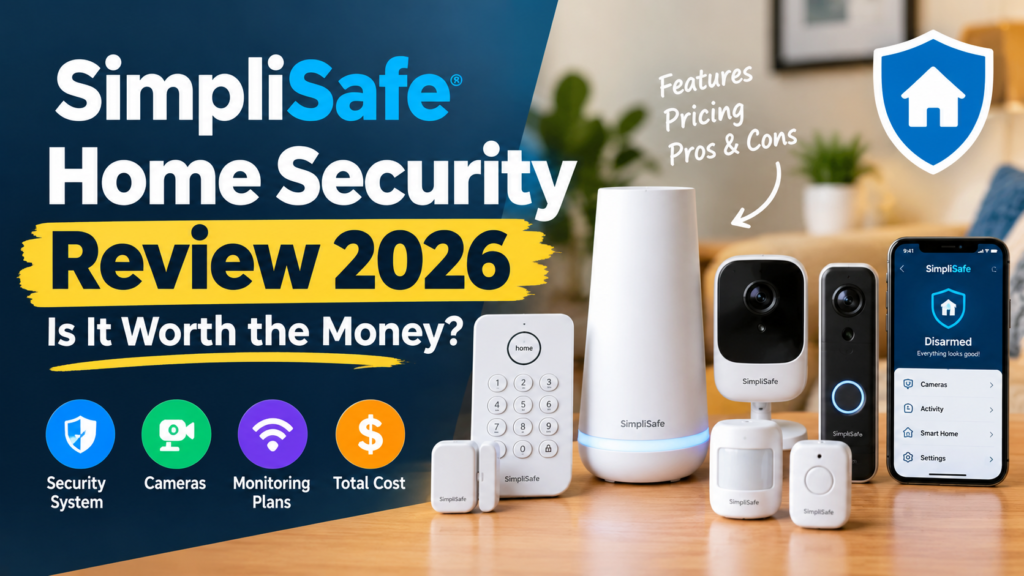
SimpliSafe has spent over a decade positioning itself as the middle ground between cheap DIY camera kits and expensive, contract-locked professional alarm systems. In 2026, that positioning has evolved significantly — the company now leans heavily on AI-assisted monitoring, proactive outdoor camera protection, and tiered subscription plans that go well beyond the simple “monitored vs. unmonitored” choice of a few years ago.
This review breaks down what SimpliSafe actually costs in 2026, what each monitoring plan includes, how the newer Active Guard Outdoor Protection feature really works, and — most importantly — whether it’s genuinely worth paying for, based on your situation. We also compare it honestly against Ring, Arlo, and Eufy, and point out where SimpliSafe still falls short.

- Simple to set up. Seriously secure – Get ready to protect right out of the box. Just plug in the Base Station, follow th…
- Smart home compatible – Arm your system at home with Google Assistant or Amazon Alexa.
If you’re still building out your broader security plan, our ultimate home security checklist is a useful companion piece before you commit to any single brand.
Quick Verdict: Is SimpliSafe Worth It?
Yes — for most renters and homeowners who want professional monitoring without a long-term contract, SimpliSafe remains one of the better value options on the market. It’s easy to self-install, the hardware is reasonably priced, and the monitoring plans (particularly Core and Pro) offer real functionality for a fair monthly cost.
It is not the best choice if you want a large, feature-rich camera ecosystem, deep smart-home integration, or the ability to run a fully capable system with zero ongoing subscription cost. If cameras and local storage are your priority, it’s worth reading our Ring vs. Arlo vs. Eufy comparison before deciding.
SimpliSafe Pros and Cons
| Pros | Cons |
|---|---|
| No long-term contracts; cancel anytime | Advanced features (video verification, Active Guard) require a paid plan |
| Easy DIY installation, no tools required | Camera selection is smaller than Ring or Arlo |
| Professional monitoring available without a contract | Smart-home integrations are more limited than competitors |
| Active Guard Outdoor Protection offers genuinely proactive deterrence | Some users report occasional connectivity/app hiccups |
| Reasonable equipment pricing for starter kits | No local/offline video storage option |
| Professional installation available in most U.S. markets | Self-monitoring tier has real limitations on emergency response |
What’s New With SimpliSafe in 2026?
The biggest shift in SimpliSafe’s offering over the past couple of years has been the move from a simple “monitored or not” model toward a layered subscription structure built around AI-assisted camera monitoring. The two headline features now central to SimpliSafe’s pitch are:
- Active Guard Outdoor Protection — proactive, AI-plus-human monitoring of outdoor cameras that can intervene before a break-in happens, not just after.
- Intruder Intervention — live monitoring agents who can view indoor camera feeds during a triggered alarm and talk directly to an intruder through the camera speaker.
SimpliSafe has also refined its plan naming (Standard, Core, Pro, Pro Plus, and a Self-Monitoring tier with camera recording), consolidated its camera lineup, and continued to sell the Video Doorbell Series 2 as its primary doorbell camera. According to SimpliSafe’s own service plan documentation, these AI-assisted features are positioned as the main differentiator against competitors like Ring and ADT.
- Simple to set up. Seriously secure – Get ready to protect right out of the box. Just plug in the Base Station, follow th…
- Smart home compatible – Arm your system at home with Google Assistant or Amazon Alexa.
How Much Does SimpliSafe Cost?
SimpliSafe’s cost has three separate components, and it’s important not to confuse them: equipment, monitoring, and optional add-ons like extra cameras or cloud video storage.
Equipment Costs
Starter kits (base station, keypad, a handful of entry and motion sensors) are typically priced from roughly $200–$300, with larger packages for bigger homes running $400–$600+. Individual components — additional entry sensors, motion sensors, glassbreak sensors, smart locks, and cameras — can be added a la carte, which is useful if you only need to cover specific doors or rooms.
Monitoring Costs
Monthly monitoring plans range from a low-cost self-monitoring option to a premium Pro Plus tier with Active Guard Outdoor Protection included. We break these down in full in the next section.
Installation Costs
Most SimpliSafe customers self-install, which costs nothing beyond the equipment itself and generally takes under an hour for a basic kit. SimpliSafe also offers optional professional installation in many U.S. markets for an additional one-time fee, which is worth considering if you’re not confident drilling sensors or mounting outdoor cameras yourself.
Cost Example Table
| Equipment | Monthly Monitoring | Estimated First-Year Cost | Best For |
|---|---|---|---|
| Basic starter kit (base station, keypad, 3 sensors) | Standard plan | Equipment + (monthly × 12) | Small apartments, renters |
| Starter kit + 1 indoor camera | Core plan | Equipment + camera + (monthly × 12) | Homeowners wanting video verification |
| Mid-size kit + indoor/outdoor cameras + doorbell | Pro plan | Equipment + cameras + (monthly × 12) | Houses with multiple entry points |
| Full kit + multiple outdoor cameras | Pro Plus plan | Equipment + cameras + (monthly × 12) | Homes prioritizing proactive outdoor deterrence |
As a rough illustration (not a guaranteed quote): a basic starter kit plus a mid-tier monitoring plan can put your realistic first-year cost somewhere in the $400–$700 range once equipment and a full year of monitoring are combined, before any add-on cameras. Ongoing yearly cost after that is essentially just 12 months of your chosen monitoring plan, plus any new equipment you add. Always check SimpliSafe’s current pricing and monitoring plan page for the exact numbers at the time you buy, since promotional discounts on starter kits are common and change frequently.
SimpliSafe Monitoring Plans Compared
This is the area where most competitor reviews get sloppy — they either quote outdated plan names or blur the line between what’s included at each tier. Here’s how the current 2026 structure breaks down.
| Plan | Approx. Monthly Cost | Professional Monitoring | Video Verification | Active Guard | Best For |
|---|---|---|---|---|---|
| Self-Monitoring w/ Camera Recording | Lowest cost, no dispatch | No | No | No | Renters who just want camera clips, no police dispatch |
| Standard | Entry-level | Yes | No | No | Budget buyers wanting basic 24/7 monitoring |
| Core | Mid-tier | Yes | Yes | No | Most homeowners; adds cellular backup and camera recording |
| Pro | Higher tier | Yes | Yes | Intruder Intervention only | Households wanting live-agent response during alarms |
| Pro Plus | Premium tier | Yes | Yes | Full Active Guard Outdoor Protection | Homes with outdoor cameras wanting proactive deterrence |
A few clarifications that are easy to miss:
- Standard gives you real professional monitoring and emergency dispatch, but monitoring agents cannot see your cameras during an event — they’re reacting to sensor triggers only.
- Core is the first tier where agents can actually view live or recorded video to verify an intrusion before calling emergency services, which speeds up response and reduces false alarms.
- Pro adds the ability for a monitoring agent to speak directly to an intruder through an indoor camera — this is Intruder Intervention, and it’s distinct from Active Guard.
- Pro Plus is the only tier that includes full Active Guard Outdoor Protection, SimpliSafe’s proactive outdoor monitoring feature.
- Cellular backup (so your system stays connected if Wi-Fi or power goes down) is generally tied to the paid monitoring plans rather than the free self-monitoring tier.
For exact current pricing, SimpliSafe’s official monitoring plan page is the only source to trust, since third-party review sites frequently lag behind price changes.
What Do You Get With a SimpliSafe System?
At its core, a SimpliSafe system is built around a wireless base station that communicates with door/window sensors, motion sensors, a keypad, and optional cameras. The base station handles local siren alerts and communicates with SimpliSafe’s monitoring center when you’re on a paid plan. Everything connects over Wi-Fi with optional cellular backup, and the whole system is managed through the SimpliSafe mobile app.
SimpliSafe Equipment and Packages
Rather than listing every SKU, here’s what actually matters for different home types:
- Base Station — The hub of the system; required for every setup. Includes a built-in siren and cellular/Wi-Fi connectivity.
- Keypad — Used for arming/disarming and entering a duress code if needed; useful if you don’t want to rely solely on the app.
- Entry Sensors — Thin magnetic sensors for doors and windows; the backbone of any starter kit.
- Motion Sensors — Best placed in hallways or main living areas rather than every room, to avoid false triggers from pets.
- Glassbreak Sensors — Worth adding for ground-floor windows in homes where an intruder might skip the door entirely.
- Indoor Cameras — Useful for verifying alarms and checking in on pets or kids; required for Intruder Intervention.
- Outdoor Cameras — Necessary if you want Active Guard Outdoor Protection; best placed covering driveways, front doors, and side gates.
- Video Doorbell Series 2 — Covers your front entry specifically; see dedicated section below.
- Smart Lock — Integrates with the system for remote locking/unlocking, useful for renters who want keyless entry without rekeying a landlord’s deadbolt.
- Smoke and CO-related sensors — Important for homes without existing integrated fire detection tied to an alarm system.
- Water and temperature sensors — Niche but valuable for basements, vacation homes, or anyone worried about frozen pipes or leaks.
- Panic button / emergency devices — Useful for elderly residents or anyone wanting a dedicated emergency trigger beyond the keypad.
A one-bedroom apartment typically only needs a base station, keypad, two or three entry sensors, and maybe one indoor camera. A detached house benefits far more from glassbreak sensors, outdoor cameras, and the Video Doorbell Series 2, since there are simply more potential entry points to cover. For a broader comparison of what counts as “enough” coverage for different home types, our DIY home security setup guide walks through sensor placement in more detail.
SimpliSafe Installation
SimpliSafe is designed for self-installation — sensors use adhesive mounts, the base station just needs power and Wi-Fi, and the app walks you through pairing each device. Most basic kits can be fully installed in well under an hour.
Professional installation is also available as a paid add-on in many areas, which makes sense for larger homes, renters who aren’t allowed to drill into window frames, or anyone installing outdoor cameras at height. If you’ve never set up a DIY system before, our DIY home security setup guide covers general best practices that apply directly to a SimpliSafe install.
SimpliSafe App Experience
The SimpliSafe app is the control center for arming/disarming, viewing camera feeds, managing sensors, and adjusting monitoring settings. It’s generally described by independent reviewers as straightforward and beginner-friendly compared to more cluttered competitor apps, though some users have reported occasional lag when pulling up live camera feeds, particularly on older phones or weaker Wi-Fi connections. This is a known limitation worth factoring in if real-time camera responsiveness is a priority for you.
SimpliSafe Security Cameras
SimpliSafe’s camera lineup is intentionally smaller than Ring’s or Arlo’s — typically one or two indoor camera models and a smaller outdoor camera range. This keeps the ecosystem simple, but it also means less flexibility if you want a wide variety of camera form factors (spotlight cameras, floodlight cameras, battery vs. wired options, etc.).
Camera recording and cloud storage generally require at least the Core plan or the dedicated self-monitoring-with-recording tier — cameras without an active plan will typically only provide live view and basic motion alerts, not stored clip history. If camera variety and advanced AI detection (package detection, vehicle detection, etc.) are a priority, it’s worth reading our security camera buying guide alongside this review, since SimpliSafe is not the strongest pure-camera option on the market.

- Wired Indoor security camera – See what’s happening inside your home. With a wide, 120 degree field of view, 1080p HD re…
- Get instant phone alerts – The SimpliSafe App notifies you the instant it detects motion so you can see what’s happening…
- Keeps you safe – Connect your camera to the latest SimpliSafe security system for award-winning 24/7 whole home protecti…
SimpliSafe Active Guard Outdoor Protection Explained
This is arguably the most important new concept in SimpliSafe’s 2026 lineup, and also the most misunderstood.
What it is: Active Guard Outdoor Protection is a proactive monitoring service for SimpliSafe’s outdoor cameras. Instead of only reacting after a sensor is triggered or a door is opened, it’s designed to flag suspicious activity — like someone lingering near a door or checking windows — before a break-in actually occurs.
How it works: SimpliSafe’s AI analyzes outdoor camera footage in real time, looking for patterns associated with “casing” behavior rather than normal activity like a delivery driver dropping off a package. When the AI flags something as suspicious, it’s escalated to a live monitoring agent.
What cameras are required: Active Guard requires compatible SimpliSafe outdoor cameras; it is not available on indoor-only setups, and it is not a feature of the standard outdoor camera motion alert system.
What the AI does vs. what the agent does: The AI’s role is filtering — reducing the enormous volume of outdoor motion events down to the ones that actually look concerning. The human agent’s role is judgment and action: reviewing the flagged clip, and if it genuinely looks like a threat, intervening.
How an agent can intervene: Where supported, an agent can speak through the camera’s two-way audio to address the person directly — for example, warning them that they’re being recorded and that authorities are being alerted — and can escalate to dispatching emergency services if the behavior continues.
How this differs from normal motion detection: Standard motion alerts just tell you “something moved.” Active Guard is attempting to distinguish between harmless motion and behavior that looks like an active threat, then adding a human decision-maker into the loop automatically rather than waiting for you to check your phone.
How this differs from Intruder Intervention: Intruder Intervention (available on the Pro plan) applies to indoor cameras after an alarm has already been triggered — it’s reactive. Active Guard Outdoor Protection is about catching suspicious activity outside, potentially before an intrusion happens at all. They’re complementary, not the same feature.
Which plans include it: Based on the current plan structure, full Active Guard Outdoor Protection is included only on the Pro Plus tier.
Is it worth the extra cost? For homes with meaningful outdoor exposure — detached houses, homes with driveways or side-yard access, properties in areas with higher package theft or break-in rates — Active Guard is a genuinely useful upgrade and one of the more credible “AI security” features on the market right now, since it still routes final judgment calls to a human rather than relying purely on automated decisions. For apartment dwellers or homes without much outdoor camera coverage, it’s not worth paying extra for. It’s worth noting that SimpliSafe is the one making these capability claims about detection accuracy and response speed; independent, large-scale testing of real-world intervention outcomes is still limited, so treat the deterrence benefits as promising rather than guaranteed. Full details are in SimpliSafe’s own Active Guard documentation.
SimpliSafe Video Doorbell Series 2
The Video Doorbell Series 2 is SimpliSafe’s current doorbell camera, covering package deliveries, visitors, and front-door activity specifically. It integrates with the same app and monitoring plans as the rest of the system, meaning recording and video verification features depend on which plan tier you’re subscribed to, just like the other cameras. It’s a solid, functional doorbell camera, though it doesn’t offer the depth of AI person/package/vehicle detection categories that some competing standalone doorbell brands provide.

- See every detail with 2K clarity, day or night. High resolution images stay crisp and clear in full daylight and after d…
- Stop crime before it starts – right at your front door. Add a professional monitoring plan with SimpliSafe Active Guard …
- Get the full picture from head-to-toe. A taller field of view means you see who’s there from anywhere.
Can You Use SimpliSafe Without a Subscription?
Short answer: partially, but with real limitations.
What continues working: The base station, sensors, and keypad will still trigger the local siren if a sensor is tripped, even with no active plan. You can still arm and disarm the system through the app and keypad.
What you lose: Without a paid plan, there is no professional monitoring, meaning no one is notified to dispatch police, fire, or medical services on your behalf — it’s on you (or whoever hears the siren) to respond. Camera cloud recording is also generally unavailable without at least the self-monitoring-with-recording tier; you may get live view, but not stored clip history. Cellular backup — which keeps the system connected if your Wi-Fi or power goes out — is tied to paid plans, so a no-subscription setup is more vulnerable to being knocked offline.
Can the app still be used? Yes, for basic control (arming/disarming, live camera view where applicable), but advanced features, alerts, and historical footage are restricted.
Who should choose self-monitoring or no subscription at all? This setup makes the most sense for people who primarily want a loud local deterrent and basic app control — for example, a renter in a low-risk building who mainly wants a visible deterrent and doesn’t need emergency dispatch tied to the system. If that’s your situation, it’s worth comparing against dedicated no-subscription systems in our guide to home alarm systems without professional monitoring, since some competitors are built from the ground up for subscription-free use in a way SimpliSafe is not.
SimpliSafe Smart Home Compatibility
SimpliSafe supports integration with major smart home platforms including Amazon Alexa and Google Assistant for voice control and basic automations (for example, arming the system via voice command). However, compared to more open ecosystems, SimpliSafe’s smart-home integration remains relatively limited — it’s not built around extensive third-party automation the way some camera-first brands are. If you’re deeply invested in a specific smart-home ecosystem already, it’s worth checking current compatibility details directly before buying, since integrations can change.
SimpliSafe Privacy and Security
SimpliSafe states that video data is encrypted and that camera footage is only accessible to account holders and, where applicable, monitoring agents responding to a verified event. As with any connected camera system, it’s worth reviewing account security basics — strong unique passwords and two-factor authentication where offered — since the weakest link in most smart home breaches is account credentials rather than the hardware itself.
What We Like About SimpliSafe
- No contracts, and monitoring can be canceled at any time
- Genuinely easy self-installation for non-technical users
- Professional monitoring is available without being locked into a multi-year agreement
- Active Guard Outdoor Protection is a credible, human-in-the-loop take on AI security rather than a pure automation gimmick
- Pricing is transparent compared to traditional contract-based alarm companies
What We Don’t Like About SimpliSafe
- Many of the most useful features (video verification, Intruder Intervention, Active Guard) are locked behind higher-tier plans
- Camera lineup is smaller and less flexible than Ring or Arlo
- No local/offline storage option for camera footage
- Smart-home integration is functional but not as deep as some competitors
- Occasional reports of app lag or connectivity hiccups, particularly on weaker home networks
- Self-monitoring/no-subscription use comes with meaningful trade-offs in emergency response and backup connectivity
SimpliSafe vs Ring, Arlo, and Eufy
| Feature | SimpliSafe | Ring | Arlo | Eufy |
|---|---|---|---|---|
| Contract required | No | No | No | No |
| Professional monitoring available | Yes | Yes (Ring Protect Pro) | Yes (Arlo Secure Plus) | Limited/varies by model |
| Proactive AI outdoor intervention | Yes (Active Guard, Pro Plus) | No (standard alerts) | Partial (AI detection, less live-agent focus) | No |
| Local video storage option | No | Limited | Some models | Yes (key differentiator) |
| Camera lineup breadth | Smaller | Large | Large | Large |
| Best known for | Whole-home alarm + monitoring | Camera + doorbell ecosystem | Camera ecosystem, wireless flexibility | Local storage, no mandatory subscription |
In short: SimpliSafe wins if you want a genuine alarm system with real monitoring options. Ring and Arlo win if you want a bigger camera ecosystem. Eufy wins if avoiding a subscription entirely is your top priority. For a deeper breakdown of the camera-specific side of that comparison, see our full Ring vs. Arlo vs. Eufy article.
Who Should Buy SimpliSafe?
- Renters — A starter kit on the Standard or Core plan gives solid coverage without modifying walls permanently, and you can take the system with you when you move.
- Homeowners wanting professional monitoring — Core or Pro strikes a good balance of video verification and reasonable monthly cost.
- People who want proactive outdoor protection — Pro Plus with compatible outdoor cameras is the clear pick if deterring would-be intruders before they reach the door matters to you.
- Budget-conscious buyers — A basic kit on the Standard plan delivers real professional monitoring at one of the more accessible price points in the category.
Who Should Skip SimpliSafe?
- People who want a large, flexible camera ecosystem — Ring or Arlo offer more camera variety and more mature app ecosystems.
- People who refuse to pay any subscription — While limited self-monitoring is possible, SimpliSafe’s most valuable features are gated behind paid plans; Eufy is a better fit for a true no-subscription setup.
- Heavy smart-home automation users already deep in a specific ecosystem — If you need extensive third-party automation beyond basic Alexa/Google voice control, SimpliSafe may feel limiting.
- Apartment dwellers in very low-risk buildings with strict installation restrictions — A simpler camera-only setup may be more practical than a full alarm system.
Is SimpliSafe Worth the Money in 2026?
Based on the current plan structure, equipment pricing, and feature set, SimpliSafe remains a strong value proposition specifically for buyers who want real professional monitoring without a long-term contract. The addition of Active Guard Outdoor Protection gives it a genuine edge over basic camera-alert competitors for homes with outdoor exposure, and the tiered plan structure means you’re not forced to pay for features you don’t need.
Where it’s less convincing is for buyers whose priority is a sprawling camera system, deep smart-home automation, or completely subscription-free operation — in those cases, competitors are simply better suited to the job.
Final Verdict
SimpliSafe earns its reputation as one of the more balanced, flexible options in home security for 2026, provided you choose the right plan for your actual needs rather than defaulting to the cheapest or most expensive tier. Match the plan to your home type and risk level, and it’s a sound investment; buy the wrong tier, and you’ll either overpay for AI features you don’t use or under-protect a home that needed more coverage.
Frequently Asked Questions
Is SimpliSafe worth it in 2026?
For most renters and homeowners wanting professional monitoring without a contract, yes. It’s less compelling if you need an extensive camera ecosystem or fully subscription-free operation.
How much does SimpliSafe cost per month?
Monitoring plans range from a low-cost self-monitoring tier with camera recording up to a premium Pro Plus plan with full Active Guard Outdoor Protection. Exact current pricing should be confirmed on SimpliSafe’s official pricing page.
Can I use SimpliSafe without a subscription?
Yes, partially. Sensors and the local siren still function, but professional monitoring, emergency dispatch, cellular backup, and camera cloud recording require a paid plan.
Does SimpliSafe require Wi-Fi?
Yes, the base station relies on Wi-Fi for full functionality, with optional cellular backup available on paid monitoring plans to keep the system connected if Wi-Fi goes down.
Does SimpliSafe call the police?
On paid professional monitoring plans, yes — monitoring agents can dispatch police, fire, or medical services after verifying an alarm event, as outlined in SimpliSafe’s alarm response documentation.
Does SimpliSafe have a camera subscription?
Camera recording and cloud storage are tied to specific monitoring plans (starting around the Core tier or the dedicated self-monitoring-with-recording plan), rather than being included free with camera hardware alone.
Is SimpliSafe good for renters?
Yes — the adhesive-based sensors and portable base station make it easy to install without permanent changes and to move with you to a new address.
What is SimpliSafe Active Guard?
Active Guard Outdoor Protection is SimpliSafe’s AI-assisted proactive monitoring feature for outdoor cameras, which flags suspicious activity for review by a live agent who can intervene before a break-in occurs. It’s included on the Pro Plus plan.
What is the difference between SimpliSafe Core and Pro?
Core adds video verification and camera recording to professional monitoring. Pro adds Intruder Intervention, allowing a live agent to speak to an intruder through an indoor camera during a triggered alarm.
What is the difference between SimpliSafe Pro and Pro Plus?
Pro includes Intruder Intervention for indoor cameras. Pro Plus adds full Active Guard Outdoor Protection for compatible outdoor cameras, enabling proactive monitoring before an alarm is even triggered.