Prices and plan terms were checked on October 20, 2026 on the official pages linked below, plus independent reviews where noted, before tax. Promotions change often. Gadget Sentinel did not hands-on test either system for this article, so every test observation is attributed to the outlet that ran it. Affiliate disclosure: some links on Gadget Sentinel are affiliate links, and we may earn a commission at no extra cost to you.
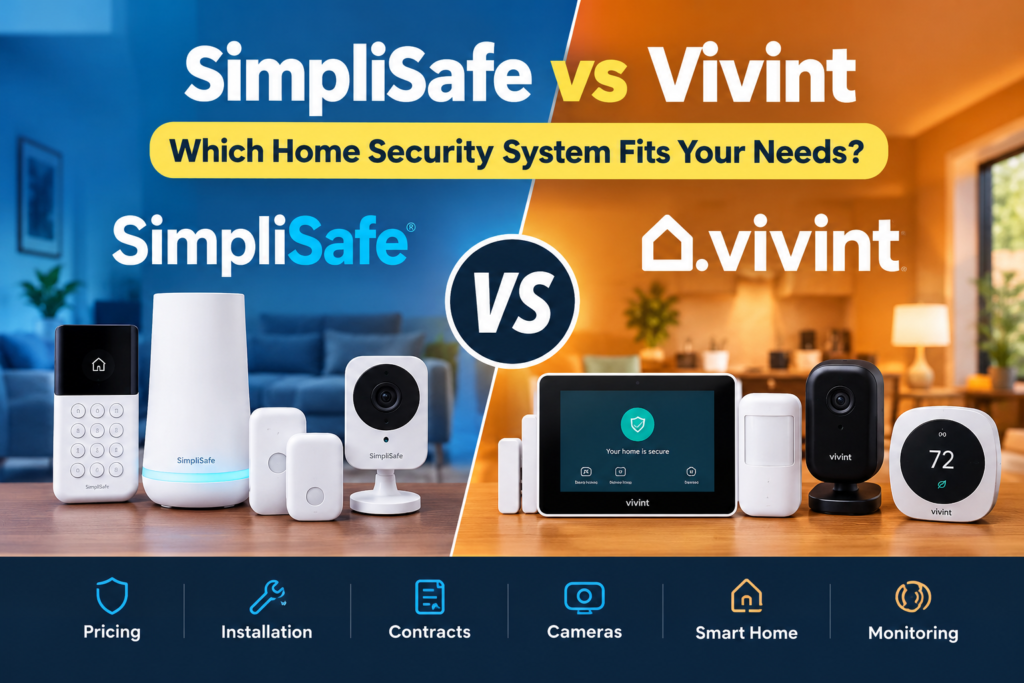
If you are weighing SimpliSafe vs Vivint, you are choosing between two different ideas of home security. SimpliSafe is a self-installed, month-to-month system. Vivint is a professionally installed system sold through a quote, with a smart-home ecosystem and financing behind it. The decision is rarely about which brand is “better.” It is about who installs it, how long you are committed, and how much smart-home depth you actually need.
The Short Answer
- Choose SimpliSafe if you rent, might move, want to leave any month, or want professional monitoring without a long commitment.
- Choose Vivint if you own your home, want a technician to install everything, and want locks, thermostats and cameras working as one system.
- Choose neither if you want fully free self-monitoring, Apple Home support, or the lowest possible recurring cost (see the last section below).
Both companies offer 24/7 professional monitoring and cellular backup. Neither can guarantee that a break-in will not happen or promise a particular police response time.

- Simple to set up. Seriously secure – Get ready to protect right out of the box. Just plug in the Base Station, download …
- 1 FREE month of professional monitoring for fast police response when you need it most. With optional monitoring service…
- Complete control of your system with the SimpliSafe App – Arm, disarm and protect anytime, anywhere.
SimpliSafe vs Vivint at a Glance
| SimpliSafe | Vivint | |
|---|---|---|
| Installation | DIY, free. Technician setup from $124.99 | Professional. Included on HomeProtect agreement offers, otherwise $199 |
| Entry package | The Starter, $282.94 list (base station, keypad, 3 entry sensors, motion sensor) | HomeProtect, $349.99 retail, or $199.99 on a 3-year agreement |
| Professional monitoring | About $22.99 to $79.99/mo across four paid tiers | $24.99 to $29.99/mo on HomeProtect. Smart-hub systems start at $44.99/mo |
| Self-monitoring | Yes, free and low-cost tiers | No, per Security.org |
| Contract | None | Optional 3-year agreement on HomeProtect. Month-to-month if you buy equipment outright |
| Financing | Up to 24-month plan via Affirm, credit check | 0% APR up to 60 months for qualified buyers |
| Cameras | Indoor, outdoor, doorbell | Indoor, two outdoor options, doorbell |
| Smart home | Alexa, Google Assistant, select locks | Z-Wave, Alexa, Google Assistant, Google Nest |
| Guarantee | 60 days, free return shipping | Confirm in writing (one reviewer reports 3 days) |
| Ideal buyer | Renters, movers, flexibility seekers | Hands-off homeowners, smart-home builders |
Sources: SimpliSafe’s official monitoring plans, SimpliSafe’s Starter page, Vivint’s HomeProtect page, and Security.org for the Starter list price and monthly equivalents.
SimpliSafe vs Vivint: Key Differences
SimpliSafe sells you equipment and lets you choose everything else: install it yourself or pay for setup, self-monitor or pay for a plan, stay or leave. Vivint sells a managed system. A technician plans and installs it, monitoring is part of the purchase, and the app ties cameras, locks and thermostats together.
Security.org, which installed both in its own home, summarized the split this way: it preferred Vivint’s premium approach, while noting SimpliSafe is the better choice for flexibility and budget. SafeHome’s side-by-side retest landed on SimpliSafe for most buyers and Vivint for homeowners with a budget and a taste for automation. Two reputable testers, two different picks. That tells you the right answer depends on the buyer.
One important caution: “Vivint” is not one product. HomeProtect is a starter bundle with its own hub, keypad and sensors. HomeProtect Pro and Vivint’s other systems use the Smart Hub and are, in Vivint’s words, compatible with the full product range. Pricing, backup power and contract terms differ between them, so do not carry one package’s numbers to the other.
Equipment and Security Features
SimpliSafe sells a base station with a 95 dB siren, a keypad, entry sensors, a pet-aware motion sensor, glass-break sensors, a panic button, a key fob, an extra 105 dB siren, and environmental sensors for water, temperature, smoke and carbon monoxide. Its keypad is designed so that smashing it still triggers an alert.
Vivint’s HomeProtect bundle includes a Security Hub, keypad, three door and window sensors, a motion sensor, a yard sign and app access, with an optional Doorbell Camera Pro version. Vivint’s fuller systems add the touchscreen Smart Hub, glass-break sensors, smoke and CO detection, water sensors, garage door control and smart locks.
Security.org counted two outdoor camera options for Vivint against one for SimpliSafe, and two indoor options for SimpliSafe against one for Vivint. Its testers also noted that Vivint’s cameras cost much more: they reported Vivint outdoor cameras at well over $300 each, enough to buy a whole SimpliSafe starter package.
Which brand has “better equipment” depends on what you value: variety and polish (Vivint) or value per dollar (SimpliSafe).
Installation and Setup
SimpliSafe is mostly peel-and-stick. Security.org reported installing it in roughly half an hour with no tools or drilling. If you would rather not, a technician setup starts at $124.99, and SimpliSafe says professional monitoring works whether you install it yourself or not. Our guide to DIY vs professional home security systems explains why installation and monitoring are separate decisions.
Vivint’s installer does it all: placement, drilling, testing and a walkthrough. Security.org called the service “white-glove,” and noted that its own install cost about $200. Vivint says professional installation is free on some offers.
Renters: SimpliSafe is the safer fit. Adhesive sensors come off without damage and the system moves with you. Vivint’s technician-based install can involve drilling, and Security.org notes that moving a Vivint system means paying Vivint to reinstall it.
Monitoring Plans and Monthly Costs
SimpliSafe’s published plans are priced per day. Independent reviewers list the monthly equivalents below.
| SimpliSafe plan | Per day | About per month | What it adds |
|---|---|---|---|
| Self Monitoring with camera recordings | 33¢ | $9.99 | Recordings, no police dispatch |
| Standard | 76¢ | $22.99 | 24/7 dispatch requests, cellular backup, remote control |
| Core | $1.10 | $32.99 | Video verification, secret alerts, 30-day storage for up to 10 cameras, Intruder Intervention with the indoor camera |
| Pro / Pro Plus | $1.66 / $2.66 | $49.99 / $79.99 | Active Guard Outdoor Protection, overnight (Pro) or 24/7 (Pro Plus) |
Vivint prices monitoring by system. HomeProtect monitoring is $24.99/mo on the 3-year agreement or $29.99/mo without one. Vivint’s smart-hub systems list monitoring “starting at $44.99/mo,” and SafeHome reports tiers at $29.99, $39.99 and $49.99 depending on whether you add automation and cameras. Security.org found that cloud video support sits in Vivint’s top tier.
Limitations to know: SimpliSafe’s higher-tier features need specific hardware, such as the Wireless Indoor Camera for Intruder Intervention and an outdoor camera for Active Guard. Vivint says that without a Vivint services plan, system functionality is limited, including loss of remote connectivity. Because monitoring prices have risen across the industry, treat any monthly figure as a snapshot.
Upfront Price and Total Cost of Ownership
This is where “which is cheaper?” gets interesting, because the answer flips depending on what you compare. All figures are list prices on October 20, 2026, in US dollars, before tax.
What is excluded: tax, shipping, first-month-free offers, sales (SimpliSafe discounts often), permits and false-alarm fees, extra sensors, and financing costs (both companies advertise 0% terms for qualified buyers, so financing does not change the totals).
Scenario A: Basic intrusion protection, no cameras
| Setup | Upfront | Monthly | 36-month total | 60-month total |
|---|---|---|---|---|
| SimpliSafe Starter, DIY, Standard plan | $282.94 | $22.99 | $1,110.58 | $1,662.34 |
| SimpliSafe Starter, technician setup ($124.99), Standard | $407.93 | $22.99 | $1,235.57 | $1,787.33 |
| Vivint HomeProtect, 3-year agreement, free install | $199.99 | $24.99 | $1,099.63 | $1,699.39* |
| Vivint HomeProtect, no contract, paid install ($349.99 + $199) | $548.99 | $29.99 | $1,628.63 | $2,348.39 |
*The 60-month Vivint figure assumes the $24.99 rate continues after the 3-year agreement ends. Confirm renewal terms before relying on it.
What this shows: on this matched, camera-free setup, Vivint’s agreement offer is within about $11 of SimpliSafe over 36 months, and SimpliSafe edges ahead by about $37 at 60 months, under the stated assumption. Vivint’s no-contract option costs roughly $520 to $690 more than SimpliSafe over the same periods. A SimpliSafe sale could erase Vivint’s small 36-month edge, and Vivint’s offers may vary by state and ZIP code.
This is not a perfect match. The Vivint package includes a professional install. SimpliSafe’s Standard plan does not include the camera-based features of Core. And Vivint’s own page says HomeProtect has a 4-hour backup battery, while SimpliSafe lists up to 24 hours (see the reliability section).
- Simple to set up. Seriously secure – Get ready to protect right out of the box. Just plug in the Base Station, download …
- 1 FREE month of professional monitoring for fast police response when you need it most. With optional monitoring service…
- Complete control of your system with the SimpliSafe App – Arm, disarm and protect anytime, anywhere.
Scenario B: Camera-equipped system
| Setup | Upfront | Monthly | 36-month total | 60-month total |
|---|---|---|---|---|
| SimpliSafe Lighthouse (Starter plus one outdoor camera), Core | $482.93 | $32.99 | $1,670.57 | $2,462.33 |
| SimpliSafe Lighthouse, Pro (outdoor Active Guard overnight) | $482.93 | $49.99 | $2,282.57 | $3,482.33 |
| Vivint smart-hub system, indicative floor | $749.99 | $44.99 | $2,369.63 | $3,449.39 |
Read the Vivint row carefully. Vivint publishes no price for camera systems. The $749.99 figure is the minimum equipment spend for its HomeProtect Pro offer, and $44.99 is the lowest published smart-hub monitoring rate. A real quote with several cameras will likely be higher: SafeHome reported sales-agent quotes of $199 for an indoor camera, $249 for a doorbell and $399 for an outdoor camera, versus roughly $149, $169 and $199 for SimpliSafe’s list prices. In Security.org’s own purchase, Vivint equipment cost $844 versus $559 for SimpliSafe, though those bundles were not identical.
Bottom line on cost: for a basic system, the 3-year gap is small if you take Vivint’s agreement. For a camera system, SimpliSafe is usually cheaper, and SimpliSafe’s overnight Active Guard tier lands near Vivint’s floor. SimpliSafe is cheaper over 3 and 5 years in most configurations, but “cheaper” and “committed” are different things. For more on budgeting, see our home security system buying guide.
Contracts, Financing and Cancellation
SimpliSafe has no contract. You can pause, downgrade or leave monthly, and you own the equipment. It also offers a 60-day return window with free return shipping.
Vivint is more layered:
- Monitoring agreement: HomeProtect offers an optional 3-year agreement for the lower price. Without it you pay more upfront and monthly.
- Financing: 0% APR for up to 60 months to qualified customers, under a separate agreement with a third-party financing partner.
- Month-to-month: Vivint says month-to-month service is available when equipment is purchased upfront.
Security.org’s takeaway is that Vivint no longer requires long contracts, but most customers still end up with one because financing requires monitoring.
Monitoring cancellation vs equipment payoff are different obligations. Cancelling monitoring does not erase a financing balance. If you cancel Vivint service, Vivint says system functionality is limited, so a financed system you stop monitoring can become a partly dead system you still owe on. SafeHome reports a 3-day window to cancel without penalty. We could not confirm Vivint’s early-termination fee or equipment-ownership terms on its public pages, so get both in writing before you sign.
Cameras, Video Storage and Privacy
Both brands deter with cameras, in different ways:
- SimpliSafe uses live agents. With Core and an indoor camera, agents can see and speak to an intruder during a verified alarm. With Pro tiers and an outdoor camera, Active Guard lets agents intervene before a door opens.
- Vivint uses automated Smart Deter, with lights and sounds responding to loitering. SafeHome notes this involves no monitoring center, which it considers better for privacy-conscious buyers.
Storage: SimpliSafe’s Core plan includes 30-day cloud storage for up to 10 cameras, and recordings alone cost about $9.99/mo. Vivint’s cloud video support sits in its top monitoring tier, per SafeHome.
Privacy: SimpliSafe’s intervention design uses the indoor camera’s privacy shutter, which opens only during an alarm. Whichever system you pick, turn on two-factor authentication, keep indoor cameras out of bedrooms and bathrooms, and understand that both are cloud-connected accounts rather than offline appliances. Our buying guide lists privacy checks worth running before any purchase.
Smart-Home Integration
Vivint is the clear leader. Security.org reports it connects to Z-Wave and Zigbee devices, including third-party brands, and works with Alexa, Google Assistant and Google Nest. SafeHome tested rule-based automations, such as flashing lights and locking a door when an intruder is detected overnight.
Access depends on the package. Vivint says HomeProtect Pro, not the basic HomeProtect bundle, is the one compatible with every Vivint smart-home product. If automation is your goal, price a Smart Hub system, not HomeProtect.
SimpliSafe is narrow. It works with Alexa and Google Assistant and pairs with August locks, and it sells its own smart lock. SafeHome found a former Nest thermostat integration no longer worked in its latest test.
Existing devices: Vivint’s Z-Wave support suggests a wider range of existing locks and thermostats will pair, but ask the installer to confirm your specific models before you buy. SimpliSafe works with a short list of third-party products. Neither is a safe assumption for Apple Home households.
Reliability, Power Outages and Internet Failures
SimpliSafe says its base station has built-in network backup and up to 24 hours of battery, which keeps professional monitoring connected during outages. Security.org’s testers saw cellular backup keep contact when their internet dropped during a storm.
Vivint’s two backup tiers differ. Its HomeProtect monitoring lists built-in cellular and a 4-hour backup battery, while its higher smart-hub tier lists built-in cellular and a 24-hour battery. SafeHome’s article says both systems have 24-hour backup, which does not match Vivint’s own HomeProtect page. Trust the manufacturer’s page and ask which battery your package has.
A limit worth knowing: cellular backup protects alarm signals. Camera video and app features generally depend on Wi-Fi and power at your router. Ask how each camera behaves offline, and consider a small battery backup for your router. Our buying guide walks through outage scenarios.
Pros and Cons of SimpliSafe
Pros
- No contract, 60-day return window, and a system you can take with you
- Cheapest entry into professionally monitored security among these two
- Live-agent intervention tiers (Intruder Intervention and Active Guard) priced well below some competitors, per SafeHome
- Free and low-cost self-monitoring options
Cons
- Smart-home integration is limited
- Higher-tier features need pricier plans plus specific cameras
- No touchscreen hub, and troubleshooting is by phone, not a technician visit
- Monitoring prices have risen, per Security.org
- Simple to set up. Seriously secure – Get ready to protect right out of the box. Just plug in the Base Station, download …
- 1 FREE month of professional monitoring for fast police response when you need it most. With optional monitoring service…
- Complete control of your system with the SimpliSafe App – Arm, disarm and protect anytime, anywhere.
Pros and Cons of Vivint
Pros
- Professional installation and an in-home service model
- Deep smart-home integration and automation
- AI-assisted cameras with automated deterrence
- 0% financing for up to 60 months for qualified buyers
Cons
- Higher total cost for camera and smart-home systems
- Financing links you to a monitoring plan and a separate lender
- No self-monitoring tier
- Pricing is quote-based, and packages vary in backup power and compatibility
Which System Is Best for Your Needs?
- Budget-conscious buyers: SimpliSafe Starter with Standard monitoring. If Vivint’s agreement offer is available and you are comfortable with 3 years, it is close on a basic system.
- Renters and frequent movers: SimpliSafe. It is portable, has no drilling, and has no long monitoring commitment. See our SimpliSafe vs Ring Alarm comparison if you already use Ring cameras.
- Homeowners who want professional installation: Vivint, or SimpliSafe with its optional technician setup if you want to avoid a commitment.
- Smart-home enthusiasts: Vivint’s smart-hub systems.
- Buyers who want advanced camera features: SimpliSafe if you want live agents watching. Vivint if you prefer automated deterrence and more camera hardware.
- Buyers who want to avoid long-term commitments: SimpliSafe.
Choose Neither If…
- You want the lowest possible bill and will reliably respond to alerts yourself. Look at self-monitored systems.
- You use Apple Home and want native support.
- You want a technician but also want to avoid a contract. Compare SimpliSafe vs ADT, including ADT’s separate DIY line.
- You are deep in the Ring ecosystem. See our Ring Alarm Pro vs SimpliSafe breakdown.
For more choices, browse our guide to other home security alternatives.
SimpliSafe vs Vivint: Final Verdict
SimpliSafe is the better fit for most renters, movers and cost-conscious buyers because it costs less once cameras are involved and never locks you in. Vivint is the better fit for homeowners who want someone else to design, install and support a connected system and will accept a quote-based price and an agreement or financing. On a basic, camera-free system, the 3-year cost gap can be close to zero, so decide on installation, flexibility and smart-home depth, not on price alone.
Before you buy, check SimpliSafe’s current packages and ask Vivint for a written quote that lists every device, the monitoring rate, the contract length, the cancellation fee and who owns the equipment.
Frequently Asked Questions
Is SimpliSafe better than Vivint?
Neither wins for every home. Security.org preferred Vivint overall, while SafeHome picked SimpliSafe for most buyers. SimpliSafe is better for flexibility and cost, and Vivint is better for professional installation and smart-home depth.
Is SimpliSafe cheaper than Vivint over three years?
Usually for camera systems. On a basic no-camera setup, Vivint’s 3-year agreement offer ($1,099.63) was about $11 below SimpliSafe Starter plus Standard ($1,110.58) at list prices on October 20, 2026. Vivint’s no-contract option cost about $518 more.
Does Vivint require a contract?
Not always. HomeProtect has an optional 3-year agreement for a lower price, and Vivint says month-to-month service is available if you buy equipment upfront. Financing requires a separate agreement with a lender, and Security.org says most customers end up with one.
Can you cancel Vivint and keep your equipment?
Vivint says system functionality is limited without a services plan, including loss of remote connectivity. Any financing balance is a separate obligation with the lender. Get the early-termination terms in writing.
Is SimpliSafe suitable for renters?
Yes. It uses adhesive sensors, needs no drilling, and has no long-term plan. Check your lease before mounting anything permanently.
Do both systems offer professional monitoring?
Yes. Both offer 24/7 monitoring with emergency dispatch. SimpliSafe also offers self-monitoring, while Vivint does not, per Security.org.
What happens if the internet goes down?
Both have built-in cellular backup for alarm signals. Camera video and some app features generally need Wi-Fi.
Which system is better for smart-home automation?
Vivint, especially its smart-hub systems.
Can existing smart-home devices work with either system?
Vivint supports Z-Wave and works with Alexa, Google Assistant and Google Nest, so many devices can pair, but confirm your models. SimpliSafe supports Alexa, Google Assistant and select locks.