
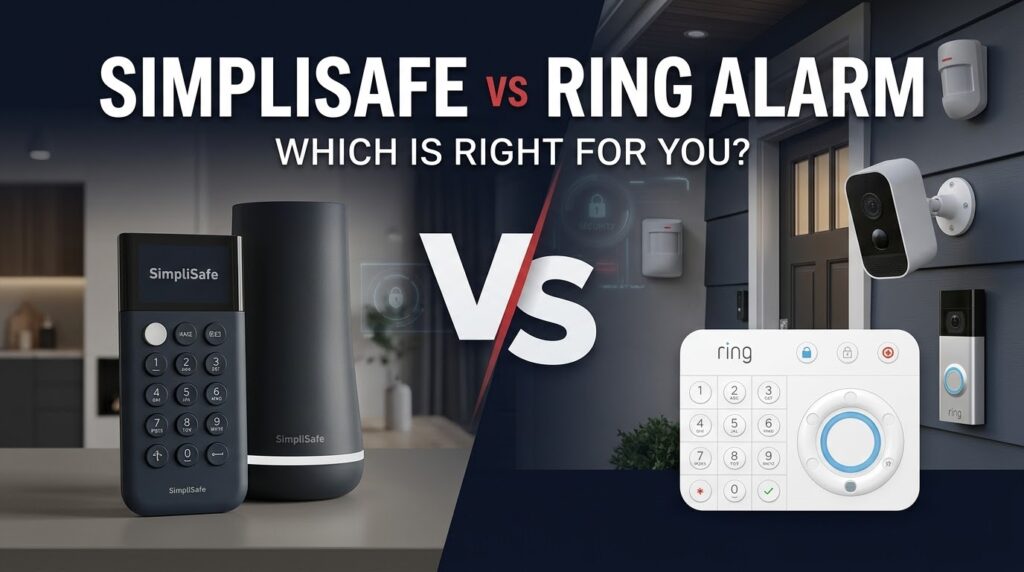
Choosing between SimpliSafe and Ring Alarm usually comes down to one question: do you want a security system that happens to have cameras, or a camera ecosystem that happens to have an alarm?
Both are DIY home security systems you can self-install in an afternoon, both skip the long-term contracts that used to define this category, and both offer professional monitoring as an optional add-on. But under the hood, they’re built around different priorities — and that affects everything from monthly cost to what happens when your Wi-Fi drops.
This guide breaks down the real differences in pricing, monitoring, hardware, smart-home compatibility, and outage resilience, so you can match the system to your actual household instead of guessing.
Editorial note on methodology: This comparison is based on publicly available manufacturer specifications, official support documentation, and independent third-party reviews current at the time of writing. Gadget Sentinel has not conducted in-house hands-on testing of either system for this article. Pricing and plan names for both SimpliSafe and Ring change periodically — confirm current figures on each company’s official site before purchasing.
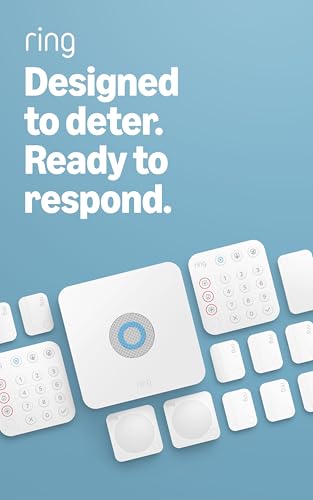
- A great fit for 2-4 bedroom homes, this Alarm Kit includes one Base Station, two Keypads, eight Contact Sensors, two Mot…
- Includes an intuitive Keypad that can arm and disarm your Alarm and Contact Sensors that detect when doors or windows op…
- Choose the Ring Alarm Kit that fits your needs and detect even more with additional Alarm Sensors and accessories (sold …
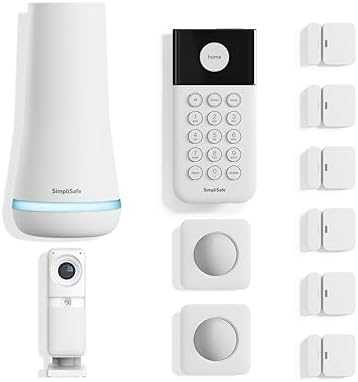
- Simple to set up. Seriously secure. Get ready to protect right out of the box. Just plug in the Base Station, place your…
- Complete control of your system with the SimpliSafe App – Arm, disarm and protect anytime, anywhere
- Stop crime in real time – With the Smart Alarm Wireless Indoor Camera and 24/7 live guard protection exclusively from Si…
Quick Answer: SimpliSafe vs Ring Alarm
Choose SimpliSafe if: you want a security-first system with built-in cellular monitoring, professional emergency dispatch, and a setup designed primarily to detect intrusions — with cameras as a supporting feature rather than the main event.
Choose Ring Alarm if: you already own Ring cameras or a video doorbell, you’re deep in the Alexa/Amazon ecosystem, and you want one app to manage alarm, cameras, and smart home devices together at a lower monthly cost.
For most security-first buyers, SimpliSafe is the stronger pick. Its monitoring plans are built around cellular backup and professional dispatch by default, which matters more to someone whose primary goal is “stop a break-in” rather than “watch my porch.”
For existing Ring/Alexa households, Ring Alarm is the more practical choice simply because of ecosystem continuity — there’s little reason to run two separate security apps when your Echo devices, doorbell, and cameras are already Ring-based.
Neither system is “better” in an absolute sense. They’re optimized for different buyers, and the table below shows exactly where those differences sit.
SimpliSafe vs Ring Alarm: At-a-Glance Comparison
| Category | SimpliSafe | Ring Alarm |
|---|---|---|
| Starting equipment cost | Starter kits generally run in the low-to-mid $200s for a basic entry/motion sensor setup | Starter kits generally run in a similar low-to-mid $200s range for a comparable 5-piece kit |
| Self-monitoring | Limited — core app control and alerts require a paid monitoring plan | Yes — free self-monitoring with app alerts and remote arm/disarm |
| Professional monitoring | Available on both monitoring tiers; included in the plan cost | Available only with Ring Protect’s plan that includes professional monitoring |
| Contract requirement | No long-term contract on standard monthly plans | No long-term contract |
| Installation | DIY, peel-and-stick/wireless sensors | DIY, peel-and-stick/wireless sensors |
| Mobile app | SimpliSafe app (full features require paid plan) | Ring app (shared across cameras, doorbells, and Alarm) |
| Alarm sensors | Entry sensors, motion sensors, glass break sensors, smoke/CO add-ons | Entry/contact sensors, motion detectors, smoke/CO listeners |
| Cameras | Indoor and outdoor cameras available as add-ons | Large lineup: indoor, outdoor, spotlight, floodlight cameras |
| Video doorbells | Available (SimpliSafe doorbell camera) | Multiple models at multiple price points |
| Alexa integration | Supported | Deep native integration (Amazon-owned) |
| Google Home integration | Supported for voice arm/disarm | Not supported |
| Cellular backup | Built into the base station’s standard operation | Available only with the plan tier that includes cellular backup |
| Battery backup | Built into base station and sensors | Built into base station and keypad |
| Home automation | Basic automations and third-party integrations | Extensive automations within Ring/Alexa ecosystem |
| Equipment expansion | Modular, easy to add sensors over time | Modular, easy to add cameras/sensors over time |
| Privacy considerations | Cloud-based video storage tied to paid plans | Cloud-based video storage tied to paid plans; broader data footprint across Amazon ecosystem |
| Warranty | Multi-year limited warranty on hardware | Standard limited warranty, extended with a Protect plan |
| Best use case | Security-first households prioritizing monitored alarm response | Camera-heavy, Alexa-connected households prioritizing visual coverage |
- A great fit for 2-4 bedroom homes, this Alarm Kit includes one Base Station, two Keypads, eight Contact Sensors, two Mot…
- Includes an intuitive Keypad that can arm and disarm your Alarm and Contact Sensors that detect when doors or windows op…
- Choose the Ring Alarm Kit that fits your needs and detect even more with additional Alarm Sensors and accessories (sold …
- Simple to set up. Seriously secure. Get ready to protect right out of the box. Just plug in the Base Station, place your…
- Complete control of your system with the SimpliSafe App – Arm, disarm and protect anytime, anywhere
- Stop crime in real time – With the Smart Alarm Wireless Indoor Camera and 24/7 live guard protection exclusively from Si…
SimpliSafe vs Ring: What Is the Difference?
The core distinction is architecture and intent.
SimpliSafe was built from the ground up as an alarm company. Its base station is the brain of the system, it communicates over a built-in cellular connection as its primary link (not just as a backup), and its monitoring plans are structured around professional emergency dispatch. Cameras exist in the lineup, but they’re accessories to the alarm system, not the centerpiece.
Ring started as a video doorbell company and expanded into alarm hardware later. Ring Alarm is genuinely capable as a DIY security system, but it lives inside the same app and account ecosystem as Ring’s cameras, doorbells, and Amazon’s broader smart home push. If you already have Ring devices or an Echo on your kitchen counter, Ring Alarm slots in with almost no friction.
Neither approach is wrong — they just serve different mental models of what “home security” means to the buyer.
SimpliSafe vs Ring Alarm: Pricing and Long-Term Cost
What you pay upfront
Both brands sell modular starter kits, and both let you add sensors and cameras individually as your needs grow. Entry-level kits from each company sit in a comparable price range, so hardware cost alone rarely decides this comparison — the ongoing monitoring fee usually does.
Monthly monitoring costs, explained
This is where buyers get confused, so here’s the breakdown:
SimpliSafe offers two main monitoring tiers. A standard professional monitoring plan covers emergency dispatch but does not include full app control or video features. A higher “interactive” tier adds remote app control, camera recording and viewing, and faster emergency response through video/audio verification. If you want to actually use the SimpliSafe app to arm, disarm, or check sensor status remotely, you generally need the higher tier — this trips up a lot of first-time buyers who assume basic monitoring includes app access.
Ring separates its plans by function. A basic Ring Protect plan covers video recording and storage for cameras but does not include professional monitoring for the Alarm system. To get 24/7 professional monitoring and cellular backup for Ring Alarm, you need the plan tier that specifically includes those features. Self-monitoring (app alerts, no professional dispatch) is free with Ring Alarm, which is not something SimpliSafe offers to the same extent — according to Ring’s official Protect plan documentation, monitoring features are tied directly to plan tier, so confirm exactly which tier includes dispatch before assuming you’re covered.
1-Year, 3-Year, and 5-Year Cost Estimate
These figures are illustrative estimates, not guaranteed pricing. They assume a buyer who purchases a basic starter kit and subscribes to each brand’s plan tier that includes professional monitoring, based on typical published pricing at the time of writing. Your actual cost depends on your specific kit, add-ons, and current promotions.
| Scenario | SimpliSafe (est.) | Ring Alarm (est.) |
|---|---|---|
| Year 1 (kit + monitoring) | ~$580–$600 | ~$470–$500 |
| Year 3 total | ~$1,250–$1,300 | ~$950–$1,000 |
| Year 5 total | ~$1,900–$1,950 | ~$1,430–$1,500 |
The pattern holds across most configurations: Ring Alarm’s professional monitoring tier is typically priced lower per month than SimpliSafe’s equivalent interactive tier, so the cost gap widens the longer you own the system. SimpliSafe’s higher price reflects its monitoring-first design and generally faster dispatch workflow — whether that premium is worth it depends on how much you value that specific feature.
Professional Monitoring Compared
Both companies contract with professional monitoring centers that can dispatch police, fire, or medical responders when an alarm triggers. The practical difference is in how monitoring is built into each ecosystem.
SimpliSafe’s base station maintains a cellular connection as a core part of its design, which means professional monitoring doesn’t depend on your home Wi-Fi staying online. Per SimpliSafe’s own monitoring plan documentation, its interactive monitoring tier also supports video verification, which can speed up emergency response because dispatchers can confirm an actual intrusion rather than relying on sensor data alone.
Ring Alarm’s professional monitoring, confirmed through Ring’s professional monitoring plan details, works similarly in function — monitoring agents are alerted on a triggered alarm and can dispatch emergency services — but cellular backup for that monitoring connection is gated behind the correct plan tier rather than built into the base hardware experience by default.
Neither company publishes independently audited average dispatch times, so treat any specific “X seconds faster” claims from either brand, or from other comparison articles, with some skepticism unless sourced directly from the company’s documentation.
Self-Monitoring Compared
If you don’t want to pay for professional monitoring at all, Ring Alarm has the clear structural advantage: you can run the system on app-based self-monitoring for free, receiving push notifications when sensors trigger and arming/disarming remotely without a subscription.
SimpliSafe’s free tier is more limited — without a paid plan, you largely lose remote app control, meaning the system functions more like a traditional local alarm (siren sounds, but limited remote visibility) rather than a fully app-monitored self-monitoring setup.
If self-monitoring without a subscription is a priority, our guide to the best home alarm systems that don’t require professional monitoring covers additional options beyond these two brands worth considering.
Installation and Setup
Both systems are designed for DIY installation with peel-and-stick sensors, wireless connectivity, and app-guided setup — no drilling, no electrician, no professional installer required for the standard kit.
Renters and apartments: Both systems work well since sensors mount with adhesive strips and can be removed without damaging walls. Ring Alarm’s smaller kits and lower entry monitoring cost can make it slightly more appealing for short-term renters who don’t want to commit to a higher monthly plan.
Small homes: Either system’s starter kit typically covers a small home’s entry points and a motion sensor or two without needing significant expansion.
Larger homes: Both brands sell additional sensors individually, so larger homes are a matter of budgeting for more hardware rather than a limitation of either platform. SimpliSafe’s base station range and sensor lineup are generally well-suited to multi-room coverage; Ring’s modular camera lineup makes it easy to extend outdoor coverage around a larger property.
For a broader walkthrough of planning sensor placement and coverage before buying anything, see Gadget Sentinel’s DIY home security setup guide and the ultimate home security checklist.
Security Sensors and Alarm Protection
Both systems offer the sensor types that actually matter for intrusion detection: door/window entry sensors, motion detectors, and glass-break sensors. Both also offer environmental add-ons like smoke and carbon monoxide detection, though the exact monitoring response for environmental alerts depends on your subscribed plan tier with each brand — check current documentation before assuming fire/CO monitoring is included automatically.
The meaningful difference isn’t the sensor list — it’s the resilience behind it. SimpliSafe’s cellular-first communication means the alarm and monitoring link are less dependent on your home internet staying up during an actual break-in, which is precisely the scenario where Wi-Fi-dependent systems are most vulnerable (a sophisticated intruder can cut power or disable Wi-Fi equipment). Ring Alarm can match this resilience, but only when you’ve subscribed to the plan tier that activates cellular backup — it is not the default behavior of a self-monitored or basic-tier setup.
Cameras and Video Doorbells
This is where Ring has a structural lead. Amazon’s backing has produced one of the largest camera and video doorbell lineups in the DIY security category — multiple doorbell models at different price points, floodlight cameras, spotlight cameras, and indoor cameras, all unified in one app with shared storage plans.
Ring makes more sense if you prioritize:
- Multiple outdoor cameras covering a property perimeter
- A video doorbell as the centerpiece of your setup
- A single Amazon account tying cameras, doorbell, and Alexa together
SimpliSafe makes more sense if you want cameras as a secondary feature supporting an alarm system you’ve already built around entry and motion sensors, rather than the primary product.
If cameras are genuinely your main priority rather than alarm sensors, it’s worth comparing Ring against other dedicated camera brands too — Gadget Sentinel’s Ring vs Arlo vs Eufy comparison and security camera buying guide cover that decision in more depth. For households still deciding how many cameras they actually need before spending on either ecosystem, see how many security cameras does your home really need.
Smart-Home Integration
Alexa: Both systems support Alexa, but Ring’s integration is deeper by nature of shared ownership under Amazon — voice commands, routines, and Echo Show video display tend to be more seamless.
Google Home: This is a genuine dealbreaker for some households. SimpliSafe supports Google Assistant integration for basic voice commands like arming and disarming. Ring does not currently support Google Home/Google Assistant integration for its devices. If your household is built around Google Nest speakers and displays rather than Amazon Echo, SimpliSafe is the only one of these two that plays nicely with your existing setup.
- A great fit for 2-4 bedroom homes, this Alarm Kit includes one Base Station, two Keypads, eight Contact Sensors, two Mot…
- Includes an intuitive Keypad that can arm and disarm your Alarm and Contact Sensors that detect when doors or windows op…
- Choose the Ring Alarm Kit that fits your needs and detect even more with additional Alarm Sensors and accessories (sold …
- Simple to set up. Seriously secure. Get ready to protect right out of the box. Just plug in the Base Station, place your…
- Complete control of your system with the SimpliSafe App – Arm, disarm and protect anytime, anywhere
- Stop crime in real time – With the Smart Alarm Wireless Indoor Camera and 24/7 live guard protection exclusively from Si…
What Happens During a Power or Internet Outage?
This is one of the most under-explained topics in most comparison articles, and it materially affects which system actually protects you during a real emergency (burglars cutting power or routers being knocked offline is not a hypothetical).
SimpliSafe:
- The base station is designed to communicate over a built-in cellular connection as its standard mode of operation, so a home internet outage does not inherently disable monitoring.
- Battery backup in the base station keeps the system running during a power outage.
- Per SimpliSafe’s support documentation on network and power resilience, core alarm and monitoring functions are designed to continue operating on cellular and battery power, though some advanced app-dependent features may be affected if your plan tier doesn’t include full interactive monitoring.
Ring Alarm:
- The base station primarily relies on Wi-Fi for its connection to the Ring app and monitoring servers.
- Cellular backup exists as a feature, but it is only active with the Ring Protect plan tier that includes it — without that subscription, an internet outage can disable remote monitoring and alerts even though local sirens may still function.
- Battery backup in the base station and keypad keeps core hardware powered during a power outage, but this does not substitute for cellular connectivity if your internet is down and you don’t have the cellular-backup plan active.
Practical takeaway: If outage resilience during an actual break-in attempt is a top priority, SimpliSafe’s architecture handles this more consistently out of the box, since cellular communication is part of its standard operation rather than a gated upgrade.
Privacy and Data Considerations
Both systems depend on cloud infrastructure for remote features, camera storage, and monitoring — there’s no fully local, cloud-free way to run either platform with full functionality.
Account ecosystem: Ring Alarm’s data lives inside the broader Amazon account and Ring ecosystem, which also powers its camera and doorbell products. That consolidation is convenient, but it also means more of your home activity data sits inside a single large company’s infrastructure. SimpliSafe’s ecosystem is narrower and more purpose-built around the alarm system itself, with a smaller surrounding product/data footprint.
Video storage: Camera footage from both brands is generally stored in the cloud under a paid plan, with retention windows and access controls defined by each company’s current terms — check the specific plan documentation rather than assuming unlimited or permanent storage.
Data controls: Both companies publish privacy policies and allow some account-level controls over data sharing and video access, but neither offers a fully local-only operating mode for their standard DIY kits. Buyers with strong privacy concerns about cloud-connected cameras in general should review independent guidance — the FTC’s consumer privacy and security guidance is a useful neutral starting point for understanding what to look for in any connected home device’s privacy practices, not specific to either brand.
Neither system should be characterized as uniquely risky — both are mainstream, widely reviewed consumer products — but buyers should go in understanding that “DIY security system” still means “cloud-connected account with a company that can access video and sensor data,” not a fully offline appliance.
SimpliSafe vs Ring Alarm for Different Types of Buyers
| Buyer type | Better fit |
|---|---|
| Renters | Ring Alarm (lower entry cost, free self-monitoring) |
| Homeowners wanting robust alarm coverage | SimpliSafe |
| Alexa households | Ring Alarm |
| Google Home households | SimpliSafe |
| Existing Ring camera owners | Ring Alarm |
| Budget buyers (lowest monthly cost) | Ring Alarm |
| Security-first buyers | SimpliSafe |
| Self-monitoring buyers (no subscription) | Ring Alarm |
| Professional-monitoring buyers | SimpliSafe (cellular-first by design) |
| Camera-heavy households | Ring Alarm |
Who Should Buy SimpliSafe?
Choose SimpliSafe if:
- Your main goal is intrusion detection and professional emergency dispatch, not camera coverage
- You want cellular monitoring built into the system rather than gated behind the top subscription tier
- You or someone in your household uses Google Assistant/Google Home
- You’re willing to pay a modestly higher monthly fee for a more monitoring-focused architecture
- You want a system that’s less tied to one large tech ecosystem
Who Should Buy Ring Alarm?
Choose Ring Alarm if:
- You already own Ring cameras or a Ring video doorbell
- Your household runs on Alexa and Echo devices
- You want the lowest-cost path to basic self-monitoring with no subscription
- Cameras and outdoor visual coverage matter more to you than alarm sensor depth
- You want one unified app for cameras, doorbell, and alarm
- A great fit for 2-4 bedroom homes, this Alarm Kit includes one Base Station, two Keypads, eight Contact Sensors, two Mot…
- Includes an intuitive Keypad that can arm and disarm your Alarm and Contact Sensors that detect when doors or windows op…
- Choose the Ring Alarm Kit that fits your needs and detect even more with additional Alarm Sensors and accessories (sold …
- Simple to set up. Seriously secure. Get ready to protect right out of the box. Just plug in the Base Station, place your…
- Complete control of your system with the SimpliSafe App – Arm, disarm and protect anytime, anywhere
- Stop crime in real time – With the Smart Alarm Wireless Indoor Camera and 24/7 live guard protection exclusively from Si…
Don’t Buy SimpliSafe If…
- You want free, full-featured self-monitoring without ever paying a subscription
- Your household is built around Alexa and you want the deepest possible smart-home integration
- You already own several Ring cameras and don’t want to manage two separate apps
- You want the largest possible camera/doorbell hardware lineup to choose from
Don’t Buy Ring Alarm If…
- You use Google Home/Google Assistant as your primary voice platform — Ring doesn’t support it
- You want cellular monitoring backup included without needing to upgrade to a higher plan tier
- Your top priority is alarm-system resilience over camera features
- You’re uncomfortable with your home security data living inside the larger Amazon ecosystem
SimpliSafe vs Ring Alarm: Final Verdict
Based on verified plan structures, monitoring architecture, and smart-home compatibility, this comparison comes down to one practical distinction: SimpliSafe is built as an alarm system first; Ring Alarm is built as part of a camera ecosystem first.
If your priority is the alarm and monitoring system itself — cellular resilience by default, professional dispatch, and an architecture that doesn’t assume your Wi-Fi will stay up during an actual break-in — SimpliSafe is the stronger, more security-first choice, even at a modestly higher monthly cost.
If your priority is cameras, a video doorbell, Alexa integration, and a lower-cost entry point with free self-monitoring — particularly if you already own Ring hardware — Ring Alarm is the more practical and cost-effective choice.
Neither system is objectively “better” across every household. But for a buyer with no existing ecosystem lock-in whose main goal is genuine break-in protection, SimpliSafe’s monitoring architecture gives it the edge. For a buyer already inside Amazon’s smart home world, or one who wants cameras as the centerpiece, Ring Alarm is the better-fitting system — not a compromise.
FAQ
Is SimpliSafe better than Ring Alarm?
SimpliSafe is generally better for buyers prioritizing a security-first system with built-in cellular monitoring. Ring Alarm is generally better for buyers prioritizing cameras, video doorbells, and Alexa integration. Neither is universally “better” — it depends on your priority.
Is Ring Alarm cheaper than SimpliSafe?
Yes, in most comparable configurations, Ring’s professional monitoring plan tier typically costs less per month than SimpliSafe’s equivalent interactive monitoring tier, and Ring also offers free self-monitoring, which SimpliSafe does not fully match.
Does SimpliSafe work without Wi-Fi?
SimpliSafe’s base station is designed to operate primarily over a built-in cellular connection, so it can continue functioning without home Wi-Fi, though confirm specific feature behavior in SimpliSafe’s current support documentation.
Does Ring Alarm work without Wi-Fi?
Ring Alarm primarily relies on Wi-Fi for its connection to the app and monitoring servers. Cellular backup is available, but only with the Ring Protect plan tier that includes it.
Which has better professional monitoring?
Both offer professional monitoring with emergency dispatch. SimpliSafe’s monitoring is built around cellular connectivity by default and includes video verification on its higher tier, which some buyers consider more robust for security-first use.
Which is better for renters?
Ring Alarm, generally, due to lower-cost entry and free self-monitoring without a subscription commitment.
Which is better for Alexa users?
Ring Alarm, due to its native Amazon ecosystem integration.
Does SimpliSafe work with Google Home?
Yes, SimpliSafe supports Google Assistant integration for basic voice commands like arming and disarming.
Can Ring Alarm be self-monitored?
Yes, Ring Alarm supports free self-monitoring with app-based alerts and remote arm/disarm, without requiring a paid subscription.
Do SimpliSafe and Ring require contracts?
No, both companies offer standard monthly plans without long-term contracts on their primary monitoring tiers.
Which system has better cameras?
Ring has a significantly larger and more varied camera and video doorbell lineup, making it the stronger choice for camera-focused households.
Which system is better for a large house?
Both systems support expansion with additional sensors and cameras, so a larger house is more a matter of budget and sensor count than a limitation of either platform.
Which is better for a security-first household?
SimpliSafe, due to its cellular-first monitoring architecture and professional dispatch design.
Pingback: Best Ring Alarm Alternatives in 2026: Top Options to Consider - Gadget Sentinel