
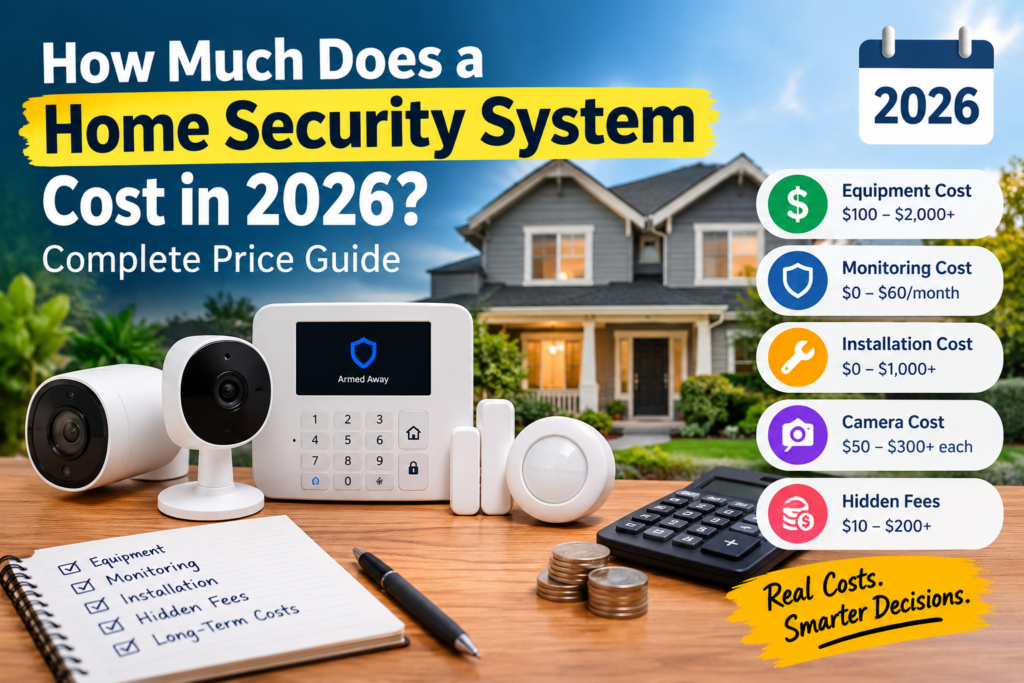
A home security system in 2026 typically costs $200 to $600 for DIY equipment or $0 to $1,500+ for a professionally installed system, plus $0 to $65 per month for monitoring. Most homeowners who want professional monitoring, a few entry sensors, a motion sensor, and one or two cameras end up spending $400 to $900 in the first year, including equipment and monitoring fees.
That’s the short answer. The real answer depends on how many doors and windows you need to cover, whether you want 24/7 professional monitoring or prefer to monitor the system yourself, how many cameras you add, and whether you sign a multi-year contract. Below, we break down every cost category — equipment, monitoring, installation, cameras, and the hidden fees most comparison articles skip — so you can build an accurate budget before you buy anything.
Home Security Cost at a Glance
| System Type | Equipment Cost | Monthly Monitoring | Installation | Typical First-Year Total |
|---|---|---|---|---|
| Basic DIY (self-monitored) | $100 – $300 | $0 | Self-install (free) | $100 – $320 |
| Mid-range DIY + professional monitoring | $250 – $600 | $15 – $30 | Self-install (free) or optional pro install $79–$150 | $430 – $960 |
| Professionally installed (contract-based) | $0 – $1,200 (often bundled) | $45 – $65 | Usually included or $0–$199 | $640 – $2,000+ |
| Advanced whole-home system | $1,500 – $5,000+ | $0 – $70 | $200 – $1,000+ (electrician/custom wiring) | $2,000 – $6,500+ |
These ranges reflect publicly listed pricing structures from major providers as of early 2026. Promotions, regional pricing, and package tiers change often, so always confirm current pricing directly on a provider’s site before purchasing.
Cost Breakdown by Category
Before comparing brands, it helps to understand what you’re actually paying for. A security system’s total cost is made up of several separate line items — some one-time, some recurring.
| Cost Category | Typical Range | One-Time or Recurring? |
|---|---|---|
| Base equipment (hub, sensors, keypad) | $100 – $600 | One-time |
| Additional sensors (door/window, glass break) | $20 – $40 each | One-time |
| Cameras (indoor/outdoor/doorbell) | $60 – $250 each | One-time |
| Professional installation | $0 – $299 | One-time |
| Activation fee | $0 – $25 | One-time |
| Basic professional monitoring | $10 – $20/month | Recurring |
| Interactive/video monitoring | $35 – $65/month | Recurring |
| Cloud video storage | $3 – $20/month | Recurring |
| Cellular backup (if not bundled) | $5 – $10/month | Recurring |
| Alarm permit (varies by city) | $0 – $100 | Often annual |
| Battery replacement | $10 – $30/year | Recurring |
| Extended warranty | $20 – $50/year | Recurring |
The key takeaway: the sticker price on a security kit is rarely the full cost. Monitoring, storage, and permits are what determine your real annual spend.
DIY vs. Professional Installation: Full Comparison
| Factor | DIY System | Professionally Installed System |
|---|---|---|
| Upfront cost | $100 – $600 | $0 – $1,200+ (often financed) |
| Installation | You install it (30–90 minutes typically) | Technician installs, usually 1 visit |
| Monitoring | Optional — self-monitor via app for free, or pay $15–$30/month | Almost always included, $45–$65/month |
| Contracts | Usually none; month-to-month | Often 24–60 month contracts |
| Equipment ownership | You own the hardware outright | You may own it, lease it, or still owe on financing |
| Flexibility to move/upgrade | High — take equipment with you | Lower — some equipment is tied to the provider |
| Long-term cost (5 years) | Often lower overall | Often higher due to monitoring fees + contract |
| Best for | Renters, tech-comfortable homeowners, smaller homes, budget-conscious buyers | Larger homes, buyers who want a single phone call for installation and support, those who prefer not to self-install wiring or large camera arrays |
If you’re comfortable mounting sensors and pairing devices through an app, a DIY home security setup can cut your total cost significantly compared to a contract-based professional install, since you avoid installation fees and long-term monitoring commitments.
How Home Size Changes the Cost
Security equipment needs scale with square footage, number of entry points, and property layout — not just personal preference. Here’s a realistic breakdown.
Apartment (1–2 bedrooms, single entry)
Typical kit: 1 video doorbell or entry sensor, 1–2 door/window sensors, 1 motion sensor, base station.
- Equipment: $150 – $250
- Monitoring: $0 (self-monitor) to $20/month
- First-year estimate: $150 – $490
Small Home (2–3 bedrooms, single story)
Typical kit: base station, 4–6 entry sensors, 1–2 motion sensors, 1 doorbell camera, 1 outdoor camera.
- Equipment: $300 – $600
- Monitoring: $15 – $30/month
- First-year estimate: $480 – $960
Medium Home (3–4 bedrooms, two stories)
Typical kit: base station, 8–10 entry sensors, 2 motion sensors, 2–3 cameras, doorbell camera, smoke/CO sensor, glass-break sensor.
- Equipment: $500 – $900
- Monitoring: $25 – $45/month
- Installation (if professional): $0 – $199
- First-year estimate: $800 – $1,800
Large Home (4+ bedrooms, multiple stories or large lot)
Typical kit: 12+ entry sensors, 3–4 motion sensors, 4–6 cameras, 2 doorbell cameras, glass-break and garage sensors.
- Equipment: $900 – $2,000+
- Monitoring: $35 – $60/month
- Professional installation: $99 – $299
- First-year estimate: $1,300 – $2,900+
Before buying equipment, map out every door, ground-floor window, and blind corner on your property — our ultimate home security checklist walks through exactly what to cover room by room so you don’t overbuy or leave gaps.
How Much Do Security Cameras Add to the Cost?
Cameras are usually the single biggest variable in a home security budget. Here’s what to expect per device:
- Indoor cameras: $30 – $60 each
- Outdoor cameras: $60 – $200 each
- Video doorbells: $60 – $250
- Floodlight cameras: $150 – $280
- Wired/PoE camera systems: $80 – $300 per camera, plus a network video recorder (NVR), often $150–$400
- Cloud video storage: $3 – $15/month per camera, or $10 – $20/month for an unlimited whole-home plan
A two-camera setup (doorbell + one outdoor camera) with cloud storage typically adds $150–$400 in equipment plus $5–$15/month to your total budget. A four-to-six camera setup with unlimited cloud storage can add $400–$1,200 in equipment plus $15–$20/month.
Wired PoE systems avoid monthly cloud fees if you record locally to an NVR, but they cost more upfront and usually need professional installation for cable runs. If you’re deciding between camera ecosystems, our security camera buying guide and our Ring vs. Arlo vs. Eufy comparison both break down subscription costs and storage limits across the most popular brands.
Hidden Costs to Watch For
Not every provider charges every fee below — but these are the costs most commonly left out of advertised pricing:
- Activation fees — $0–$25 one-time charge to start a monitoring plan
- Professional installation — $0–$299, sometimes “free” only with a multi-year contract
- Extra sensors or cameras — $20–$250 each beyond what’s included in a starter kit
- Cloud video storage — $3–$20/month, often required to review recorded footage later
- Cellular backup — keeps the system online if Wi-Fi or power fails; sometimes bundled, sometimes $5–$10/month extra
- Alarm permits — many cities and counties require a registered alarm permit, typically $0–$100, to reduce false-alarm dispatches
- Sales tax — varies by state and can apply to both equipment and monitoring in some states
- Batteries — sensors typically need replacement batteries every 1–3 years ($10–$30/year total)
- Service calls — $50–$150 if a technician visit is needed after the warranty period
- Extended warranties — $20–$50/year or a flat $50–$150 one-time fee
- Financing charges — some professionally installed systems offer 0% APR promotions, but interest can apply if the balance isn’t paid within the promo window
- Early termination fees — contract-based providers can charge the remaining contract balance if you cancel early, which can total $200–$1,500+ depending on months remaining
Door-to-door and in-home sales contracts for security systems are also covered by federal consumer protection rules that give buyers a short window to cancel after signing — it’s worth knowing your rights before committing to a multi-year agreement, as outlined in the FTC’s rule on door-to-door sales.
Major Brand Pricing (2026)
Pricing structures below reflect publicly listed starting rates and plan tiers. Promotions, bundle discounts, and regional pricing change frequently — always confirm current rates directly with the provider before purchasing.
| Brand | Equipment Starting Price | Monthly Monitoring | Contract Required? |
|---|---|---|---|
| SimpliSafe | ~$200–$600 (kits) | ~$18–$30 | No |
| Ring Alarm | ~$200–$250 (5-piece kit) | $0 (self-monitor), $4.99–$20 (Ring Protect plans) | No |
| ADT | Often bundled/financed, or $400+ outright | ~$45–$65+ | Typically 24–36 months |
| Vivint | Financed or $599+ outright | ~$30–$45+ | Typically 42–60 months, or no contract if paid in full |
| Frontpoint | ~$100–$500 (kits) | ~$35–$50 | No long-term contract |
| Google Nest (cameras + Nest Aware) | ~$100–$200 per camera | ~$8–$15 per plan tier | No |
| Arlo | ~$100–$250 per camera | ~$8–$15 per plan tier | No |
For current pricing details, SimpliSafe and Ring both publish full equipment and monitoring breakdowns on their own sites — see SimpliSafe’s current packages and Ring’s Protect Plan pricing for exact tier details. Contract-based providers like ADT and Vivint typically bundle equipment into financing or a monitoring contract rather than selling it outright, which is why their upfront equipment price is harder to pin down in isolation.
If you’d rather skip professional monitoring and contracts entirely, our guide to home alarm systems without professional monitoring covers self-monitored options that still send mobile alerts without a recurring fee.
First-Year, 3-Year, and 5-Year Ownership Costs
Advertised monthly prices look small, but they add up. Here’s the math across three common ownership paths, using simple, consistent assumptions.
Scenario A: DIY, self-monitored (no monthly fee)
Equipment: $300 one-time. Assume ~$20/year in battery replacements and minor accessories.
- Year 1: $300 + $20 = $320
- Year 3: $300 + ($20 × 3) = $360
- Year 5: $300 + ($20 × 5) = $400
Scenario B: Mid-range DIY + professional monitoring at $25/month
Equipment: $400 one-time. Monitoring: $25/month = $300/year.
- Year 1: $400 + $300 = $700
- Year 3: $400 + ($300 × 3) = $1,300
- Year 5: $400 + ($300 × 5) = $1,900
Scenario C: Professionally installed and monitored, $50/month, $99 install fee, bundled equipment
A $30/month plan alone becomes $360/year, $1,080 over three years, and $1,800 over five years just in monitoring — before any install fee or contract terms. At $50/month with a $99 install fee:
- Year 1: $99 + ($50 × 12) = $699
- Year 3: $99 + ($50 × 36) = $1,899
- Year 5: $99 + ($50 × 60) = $3,099
The pattern is consistent: self-monitored DIY is cheapest over time, mid-range DIY with monitoring sits in the middle, and contract-based professional monitoring costs the least upfront but the most over 3–5 years. If you cancel a contract-based plan early, add the early termination fee on top of these totals.
Is Monthly Monitoring Necessary?
No — it’s optional. A security system without a monthly fee will still trigger a loud alarm and send mobile alerts, but no one will automatically contact police or fire services on your behalf. Professional monitoring adds a human response layer: if a sensor trips, a monitoring center calls to verify, then dispatches emergency services if needed.
Some homeowners insurance providers offer discounts for monitored systems, which can partially offset the monthly cost — check with your insurer for the specific discount amount, since it varies widely by company and state. Self-monitoring is a reasonable choice for apartments, smaller homes, or anyone comfortable responding to alerts personally; professional monitoring makes more sense for larger properties, frequent travelers, or households that want guaranteed emergency dispatch.
Which Option Gives the Best Value?
- Renters and apartment dwellers: Basic DIY, self-monitored — lowest cost, no installation, portable.
- Small to medium homes on a budget: Mid-range DIY with a no-contract monitoring plan — balances cost and emergency response.
- Homeowners who want installation handled for them: Professionally installed system — higher long-term cost, but no setup work and often bundled smart-home features.
- Large or complex properties: Advanced whole-home systems with PoE cameras — higher upfront investment, but better coverage and no recurring cloud storage fees if recording locally.
There’s no single “best” system — the right choice depends on how much coverage your home needs, whether you want ongoing emergency dispatch, and how you feel about contracts.
Frequently Asked Questions
How much does a home security system cost on average in 2026?
Most homeowners spend $200–$600 on DIY equipment plus $0–$30/month for monitoring, or $0–$1,200 upfront with $45–$65/month for a professionally installed, contract-based system.
Is there a home security system with no monthly fee?
Yes. Many DIY kits (Ring, SimpliSafe, Wyze, and similar brands) can be self-monitored through a mobile app at no recurring cost, though you won’t get automatic police or fire dispatch.
How much does professional installation cost?
Independent installation typically runs $99–$299. Contract-based providers like ADT and Vivint often include installation for free or a reduced fee as part of a multi-year monitoring agreement.
How much do security cameras add to the total cost?
Expect $60–$250 per camera or doorbell, plus $3–$20/month per camera (or $10–$20/month unlimited) for cloud video storage if you want recorded footage beyond live viewing.
Do home security systems require a contract?
Not always. DIY brands like SimpliSafe, Ring, and Frontpoint typically offer month-to-month plans. Traditional professional providers like ADT and Vivint commonly require 24–60 month contracts, especially when equipment is financed or bundled.
What hidden fees should I watch for?
Activation fees, alarm permits, cloud storage, cellular backup, extended warranties, and early termination fees are the most commonly overlooked costs — not every provider charges all of them.
Is DIY or professional monitoring cheaper over time?
DIY self-monitoring is almost always cheapest over 3–5 years. Professional monitoring costs less upfront but accumulates significantly through monthly fees and potential contract penalties.
Does a security system guarantee my home won’t be broken into?
No system can guarantee protection. A monitored or self-monitored security system reduces risk and improves response time, but it does not prevent every possible break-in or emergency.
Do I need a permit for a home alarm system?
Many cities and counties require a registered alarm permit, typically a one-time or annual fee between $0 and $100, intended to reduce false-alarm emergency dispatches. Requirements vary by municipality, so check with your local government before installation.
What’s a realistic first-year budget for a typical home?
For a small-to-medium home with a handful of sensors, one or two cameras, and professional monitoring, a realistic first-year budget is $600–$1,800, including equipment, monitoring, and incidental fees.
Pingback: Ring Alarm Pro Review 2026: Is This Smart Security System Worth It? - Gadget Sentinel